
Index Funds vs. Actively Managed Funds: What the Distinction Means
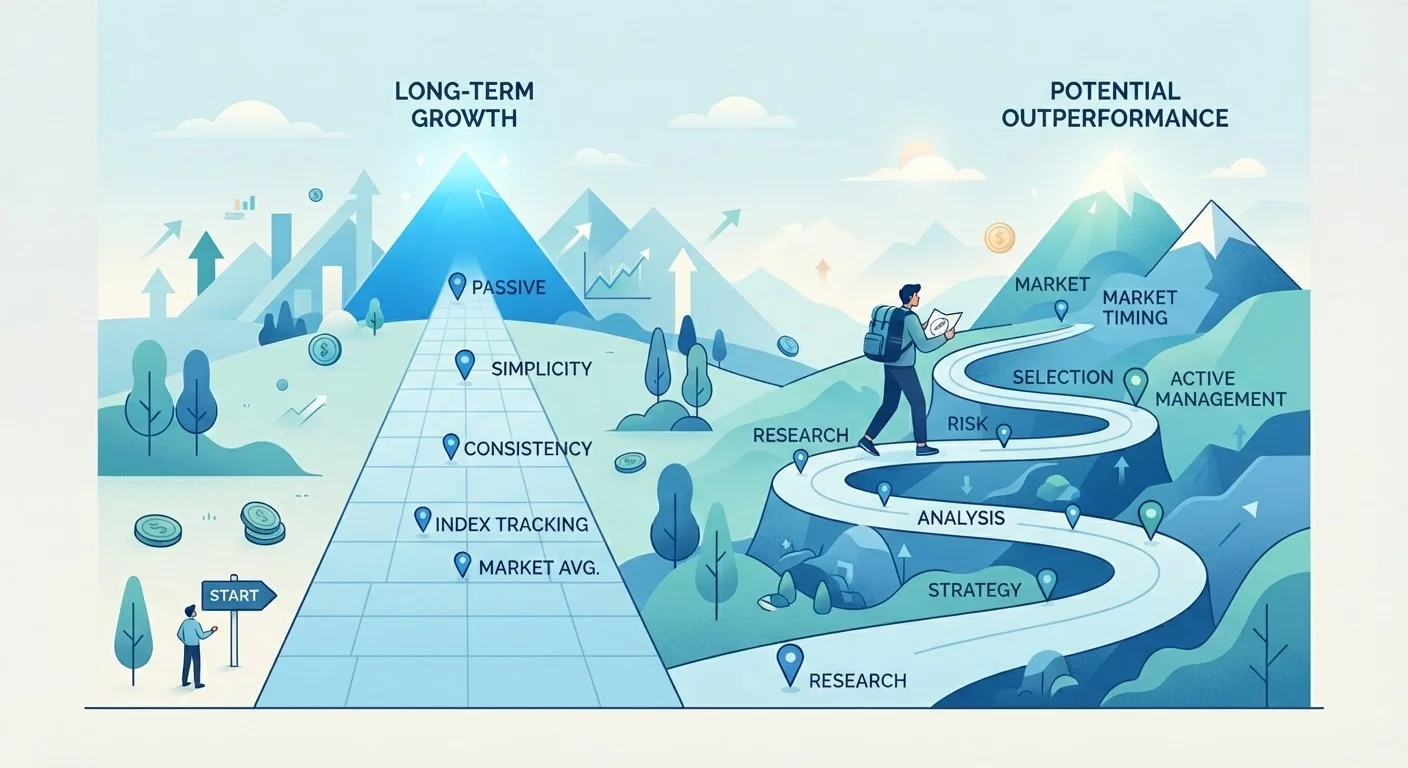
Photo credit: AdvisorHQ.net | Informative Website
In this article
Index funds and actively managed funds take opposite approaches to building a portfolio. Here's what sets them apart conceptually.
Key Takeaways
- Index funds track a market index automatically; actively managed funds rely on human managers making deliberate investment decisions.
- Expense ratios for actively managed funds tend to be significantly higher than those for index funds.
- Research consistently shows most actively managed funds underperform their benchmark index over long time horizons.
- Neither approach eliminates investment risk - both can lose value depending on market conditions.
- Both fund types can be held inside tax-advantaged accounts like 401(k)s and IRAs.
The Core Distinction: How Each Fund Is Run
At their most fundamental level, index funds and actively managed funds differ in who - or what - makes the investment decisions.
An index fund is designed to replicate the performance of a specific market index, such as the S&P 500 or the Bloomberg U.S. Aggregate Bond Index. The fund holds the same securities as the index, in roughly the same proportions, and adjusts only when the index itself changes. There is no portfolio manager deciding which stocks to favor or avoid - the process is automated and rule-based.
An actively managed fund, by contrast, employs a portfolio manager (or a team) who researches securities, forms views on the economy and individual companies, and makes deliberate buy-and-sell decisions. The stated goal is to outperform a benchmark index - not merely match it.
This difference in structure shapes nearly every other dimension of comparison: cost, consistency, and the expectations investors should carry into either choice. To understand how fund investing fits into a broader financial plan, it helps to first understand the distinction between saving and investing generally - see our overview of saving vs. investing for context.
| Criterion | Index Funds | Actively Managed Funds |
|---|---|---|
| Decision-making | Rules-based, tracks an index | Human manager makes active choices |
| Stated goal | Match benchmark performance | Outperform a benchmark |
| Typical expense ratio | Generally lower | Generally higher |
| Portfolio turnover | Low - changes only when index changes | Often higher - reflects manager decisions |
| Long-term performance vs. benchmark | Closely tracks benchmark | Most underperform benchmark after fees |
| Transparency of holdings | High - mirrors known index | Varies - disclosed periodically |
| Market risk | Present - can lose value | Present - can lose value |
Costs, Performance, and What the Evidence Shows
One of the most consequential differences between these fund types is cost. Index funds carry lower expense ratios - the annual fee expressed as a percentage of assets - because they require minimal active management. Actively managed funds must pay for research, analysis, and portfolio manager salaries, which feeds into higher ongoing costs for the investor.
Over long holding periods, even a seemingly small difference in expense ratios can substantially affect the total value of an investment through the mechanics of compounding.
~85%
Active large-cap funds underperforming over 10 years
According to S&P Dow Jones Indices SPIVA reports, roughly 85% of actively managed U.S. large-cap funds underperformed the S&P 500 over a 10-year period in multiple recent annual studies.
~1%+
Typical annual expense ratio gap
Actively managed equity funds have historically carried expense ratios averaging around 1% or more annually, compared to a fraction of that for many index funds, according to industry data from Morningstar.
Decades
Timeframe where cost differences compound most
Financial educators widely note that even a 0.5-1% annual fee difference can result in meaningfully lower ending balances over a 20-30 year investment horizon due to compounding.
The performance record of actively managed funds versus their benchmarks is a well-studied area of finance. Broad analyses - including the S&P Indices Versus Active (SPIVA) reports published by S&P Dow Jones Indices - have consistently found that the majority of actively managed funds underperform their relevant index benchmarks over periods of ten years or more, after fees. There are exceptions, and some managers have demonstrated sustained skill, but identifying those managers in advance is itself a difficult challenge.
It is important to note: neither fund type eliminates market risk. Both index and actively managed funds can and do lose value when markets decline. Past performance of any fund does not guarantee future results.
This article is for general informational and educational purposes only. It is not personalized investment, financial, or tax advice. Please consult a qualified financial adviser before making investment decisions suited to your own circumstances.
Practical Considerations for Everyday Investors
Understanding the conceptual difference between these fund types becomes more useful when you connect it to practical decisions - particularly around account structure and personal goals.
Both index funds and actively managed funds can be held inside tax-advantaged accounts such as 401(k)s and IRAs, which can affect how gains, dividends, and withdrawals are treated for tax purposes. Our guide to 401(k)s and IRAs explains how these account types work and how they differ from each other.
When evaluating either type of fund, a few factors are worth understanding clearly:
- Expense ratio: The annual cost charged to fund investors, expressed as a percentage of assets under management.
- Benchmark: The index a fund is measured against - active funds aim to beat it; index funds aim to match it.
- Turnover: How frequently a fund buys and sells securities. Higher turnover in actively managed funds can generate taxable events in non-sheltered accounts.
- Investment objective: What the fund is trying to achieve, and whether that aligns with your financial goals and time horizon.
No single approach is universally correct. The distinction between these fund types is a foundational concept - understanding it helps investors ask better questions and interpret the choices available to them, whether in a workplace retirement plan or a personal brokerage account.

Author
Finance Editorial Team
Finance Editorial Team is the collective byline for our editorial team and contributor network. Articles published under this byline or an editorial pen name are researched, written, and reviewed according to our editorial standards for clarity, consistency, and independence before publication.
View all articles →