
Home Workout vs. Gym Membership: Weighing the Trade-Offs
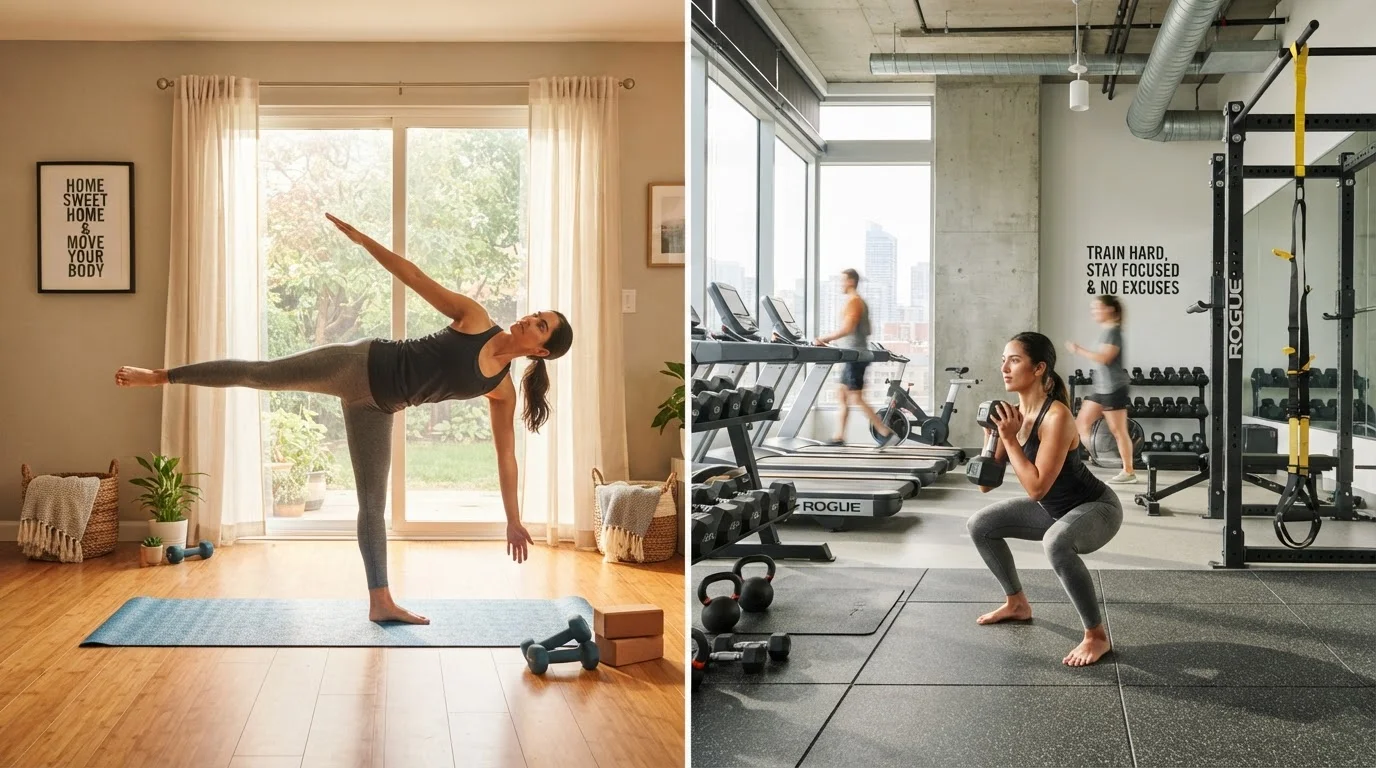
Photo credit: AdvisorHQ.net | Informative Website
In this article
Cost, convenience, accountability, and equipment access all factor into this decision. A balanced look at what each option realistically offers.
Key Takeaways
- Home workouts eliminate commute time and gym fees but require self-motivation and creative space use.
- Gym memberships provide equipment variety and a structured environment that supports accountability.
- Neither option is universally superior - sustainability matters more than the setting.
- Beginners can build effective habits in either environment with the right approach.
- Hybrid approaches - using both settings at different times - are increasingly common and practical.
No commute - exercise whenever it fits your day
Removing travel time eliminates one of the most commonly cited barriers to consistent exercise. A short session becomes far more realistic when it starts the moment you roll out a mat.
Lower ongoing cost after initial setup
Once basic equipment is in place - such as resistance bands, a mat, or a set of dumbbells - the monthly cost of home training is essentially zero, compared to recurring membership fees.
Full control over environment and schedule
You choose the music, temperature, and timing without waiting for equipment or navigating crowded peak hours. This level of control appeals especially to people with irregular work schedules.
Privacy supports confidence for beginners
Many people new to exercise feel self-conscious in public gym settings. Working out at home removes that social pressure, which can lower the threshold to getting started.
Bodyweight and low-impact options are highly accessible
Exercises like squats, lunges, push-ups, and yoga flows require no equipment and are well-supported by free or low-cost video resources, making them genuinely accessible to most people.
Limited equipment restricts certain training goals
Heavy compound lifts, cable machines, and specialty cardio equipment are difficult or expensive to replicate at home. This can create a ceiling for those pursuing specific strength or performance goals.
Distractions and space constraints reduce focus
Household responsibilities, family members, limited floor area, and the general comfort of home can make it harder to enter a focused workout mindset consistently.
Self-motivation must come entirely from within
Without the ambient energy of a gym, scheduled classes, or a trainer, sustaining long-term commitment relies heavily on internal discipline - a genuine challenge for many people.
Upfront equipment costs can add up
Quality dumbbells, kettlebells, or a pull-up bar involve real investment. Those costs can rival or exceed a year of gym membership fees depending on what you buy.
No access to professional guidance on-site
Form corrections, personalized programming, and safety oversight are harder to access at home, which can be a concern for beginners learning movements for the first time.
Understanding What Each Option Actually Offers
The home workout versus gym membership debate is often framed as a cost comparison, but the real differences run deeper. Each setting creates a distinct exercise experience - one defined by autonomy, the other by infrastructure.
Home workouts center on convenience and flexibility. You set the rules. Gym memberships offer an environment specifically designed for exercise: purpose-built equipment, regulated space, and often a social dimension that home training simply cannot replicate. For beginners especially, understanding these structural differences matters more than counting dollars per month.
It's also worth noting that this isn't a permanent, either-or decision. Many people shift between approaches as their lives, goals, and budgets evolve. Others combine both - using home sessions for quick weekday workouts and the gym for more intensive weekend training. The type of training you prefer may also steer you naturally toward one setting over the other.
The Case for Working Out at Home
Home training has grown substantially as a mainstream fitness approach, and for good reason. The removal of travel time alone addresses one of the most commonly reported obstacles to regular exercise.
No commute - exercise whenever it fits your day
Removing travel time eliminates one of the most commonly cited barriers to consistent exercise. A short session becomes far more realistic when it starts the moment you roll out a mat.
Lower ongoing cost after initial setup
Once basic equipment is in place - such as resistance bands, a mat, or a set of dumbbells - the monthly cost of home training is essentially zero, compared to recurring membership fees.
Full control over environment and schedule
You choose the music, temperature, and timing without waiting for equipment or navigating crowded peak hours. This level of control appeals especially to people with irregular work schedules.
Privacy supports confidence for beginners
Many people new to exercise feel self-conscious in public gym settings. Working out at home removes that social pressure, which can lower the threshold to getting started.
Bodyweight and low-impact options are highly accessible
Exercises like squats, lunges, push-ups, and yoga flows require no equipment and are well-supported by free or low-cost video resources, making them genuinely accessible to most people.
Beginners often find that starting at home reduces the intimidation factor enough to actually begin moving consistently. Low-impact exercise options - yoga, walking in place, resistance band work - translate well to home environments and require minimal space or equipment. Over time, those small habits can build a durable fitness foundation.
The financial argument is real but nuanced. Home training costs less month-to-month once equipment is in place, but the upfront investment matters. A single quality set of adjustable dumbbells can cost as much as several months of a mid-range gym membership.
The Case for a Gym Membership
Gyms exist because exercising in a dedicated space - surrounded by equipment and other people in motion - works for a large segment of the population. The environmental cues alone can shift behavior: when you're at the gym, the context signals that it's time to train.
Limited equipment restricts certain training goals
Heavy compound lifts, cable machines, and specialty cardio equipment are difficult or expensive to replicate at home. This can create a ceiling for those pursuing specific strength or performance goals.
Distractions and space constraints reduce focus
Household responsibilities, family members, limited floor area, and the general comfort of home can make it harder to enter a focused workout mindset consistently.
Self-motivation must come entirely from within
Without the ambient energy of a gym, scheduled classes, or a trainer, sustaining long-term commitment relies heavily on internal discipline - a genuine challenge for many people.
Upfront equipment costs can add up
Quality dumbbells, kettlebells, or a pull-up bar involve real investment. Those costs can rival or exceed a year of gym membership fees depending on what you buy.
No access to professional guidance on-site
Form corrections, personalized programming, and safety oversight are harder to access at home, which can be a concern for beginners learning movements for the first time.
Access to a full range of equipment is perhaps the clearest practical advantage. Cable machines, barbells, squat racks, rowing machines, and group fitness classes are difficult or impossible to replicate at home without significant expense. For anyone targeting specific strength benchmarks or athletic performance, this access matters.
The social dimension also carries real weight. Whether it's a group fitness class, a regular workout partner, or simply the ambient motivation of seeing others train, gyms offer a degree of accountability that home environments typically don't. If you find yourself drawn to structured environments, it's worth factoring that honestly into your decision. Those prone to workout plateaus may also find that varied gym equipment and class formats help break monotony.
This Is General Fitness Information
The content in this article is intended for general educational purposes only and does not constitute medical or personal training advice. Individual fitness needs vary widely, particularly for those with existing health conditions, injuries, or special considerations. Always consult a qualified healthcare or fitness professional before starting or significantly changing an exercise program.
Making the Decision That Actually Sticks
Sustainable exercise is the goal - not the perfect setting. Research consistently shows that adherence matters more than the specific method, and the environment you'll actually use regularly is the one worth choosing.
~$40-$70
Average monthly US gym membership cost
Industry surveys consistently place standard gym memberships in this range, though premium facilities and classes can cost significantly more.
3 in 10
Americans who exercise at home regularly
According to recurring surveys by fitness and health research organizations, home-based physical activity is a common and growing part of Americans' routines.
67%
Gym members who rarely or never use their membership
Estimates from consumer behavior research suggest a significant portion of gym subscribers attend infrequently, making cost-effectiveness a valid concern.
Consider your honest patterns: Do you need external structure to follow through, or does autonomy help you stay consistent? Is your home environment conducive to focused movement? Can you afford a membership that you'll genuinely use? These questions are more useful than comparing equipment lists.
For those working from home already, the line between productive work time and personal wellness time can blur. Remote work carries its own wellness trade-offs, and a gym membership may serve as a meaningful reason to leave the house and shift mental gears - a benefit that doesn't show up in equipment comparisons. Conversely, if your schedule is genuinely unpredictable, even simple at-home movement like walking may be the more realistic cornerstone of your routine.
This article is for general informational and educational purposes only and is not a substitute for professional medical or fitness advice. Consult a qualified healthcare provider or certified fitness professional before beginning any new exercise program.

Author
Health & Beauty Editorial Team
Health & Beauty Editorial Team is the collective byline for our editorial team and contributor network. Articles published under this byline or an editorial pen name are researched, written, and reviewed according to our editorial standards for clarity, consistency, and independence before publication.
View all articles →