
Tokyo or Kyoto: Choosing the Right Japanese City for Your Travel Style
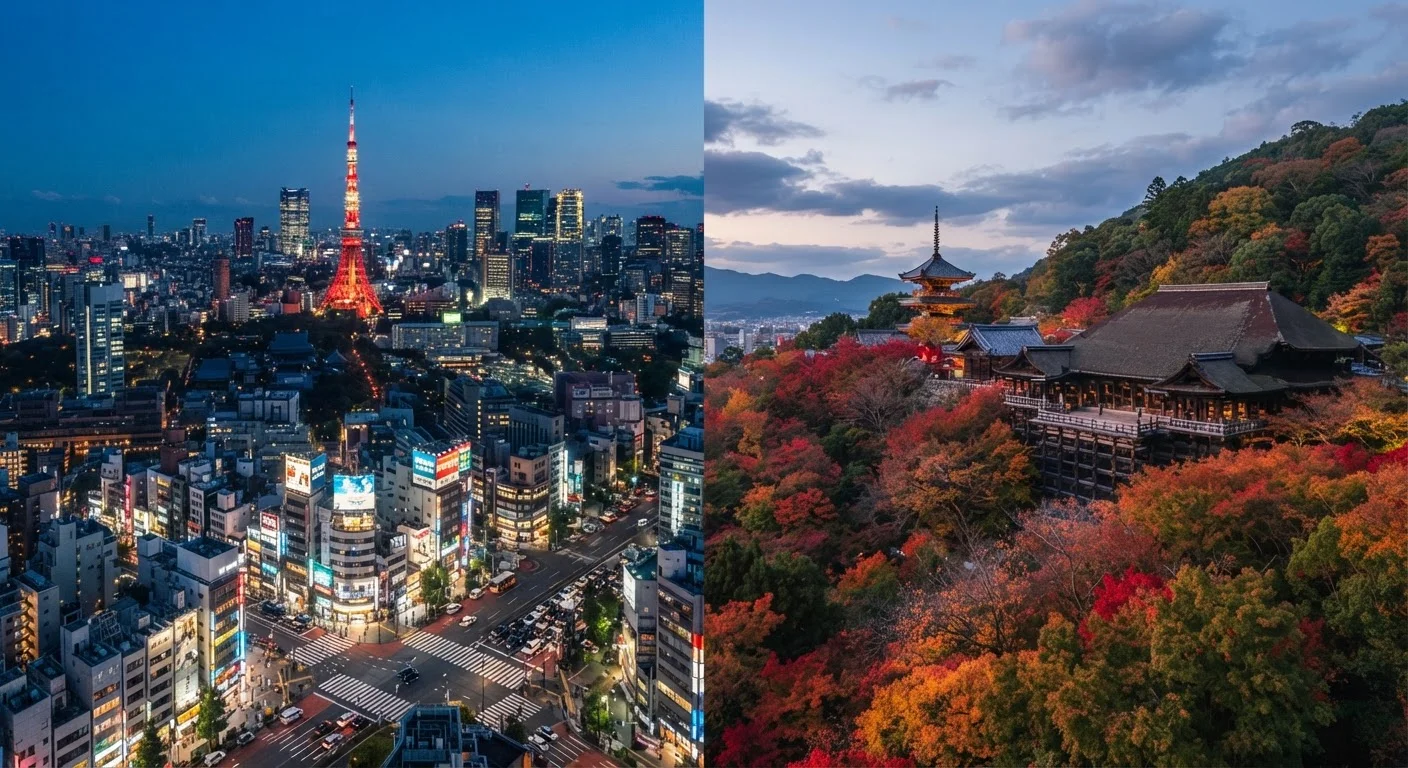
Photo credit: AdvisorHQ.net | Informative Website
In this article
Modern metropolis or ancient capital? Compare Tokyo and Kyoto across culture, pace, cost, and experience to find your fit.
Key Takeaways
- Tokyo suits travelers who want a fast-paced urban experience with world-class food, pop culture, and modern architecture.
- Kyoto is the go-to destination for traditional Japanese culture, historic temples, and geisha districts.
- Tokyo is generally more expensive for accommodation, while Kyoto can be pricier for cultural experiences and dining.
- Both cities are well-connected by the shinkansen (bullet train), making a combined visit entirely practical.
- Season matters: Kyoto's cherry blossom and autumn foliage periods draw large crowds and require advance planning.
- Neither city is objectively better - the right choice depends entirely on what kind of trip you're after.
City Character: Electric vs. Ancient
Tokyo is one of the most densely stimulating cities on the planet. From the teen fashion spectacle of Harajuku to the quiet literary streets of Yanaka, it contains multitudes - and rewards travelers who enjoy getting pleasantly lost. The city is a living experiment in reinvention, constantly layering the ultramodern over traces of old Edo.
Kyoto operates at an entirely different frequency. As Japan's imperial capital for over a millennium, it carries that history in every stone lantern and moss-covered garden path. Walking the Philosopher's Path or stepping into Fushimi Inari at dawn, you sense that the city considers itself a guardian of something worth protecting. That sense of cultural weight is Kyoto's most distinctive quality - and the reason many travelers feel it's Japan's most meaningful destination.
Neither temperament is superior. What matters is which energy matches your travel personality. For help thinking through how to structure time between two cities like these, these itinerary-building principles offer a practical starting framework.
Culture, Food, and Day-to-Day Experience
Tokyo's food scene is staggering in scope - from Michelin-starred omakase to standing ramen bars at 2 a.m. The city's neighborhoods each carry a distinct personality: Shibuya and Shinjuku for buzzing commercial energy, Shimokitazawa for vintage shops and live music, Akihabara for electronics and anime culture. Museums range from the world-class teamLab digital art spaces to intimate local galleries.
Kyoto's cultural offerings are narrower but deeper. The Gion district still hosts practicing geiko (the Kyoto term for geisha) and offers some of Japan's most atmospheric evening walks. Tea ceremony experiences, Noh theater performances, and tofu kaiseki (multi-course cuisine) dining give visitors access to living traditions with centuries of refinement behind them. Temples like Kinkaku-ji (the Golden Pavilion) and Ryoan-ji's famous rock garden are legitimately moving in person.
| Criterion | Tokyo | Kyoto |
|---|---|---|
| Overall pace | Fast, high-energy | Slower, contemplative |
| Cultural focus | Modern, eclectic, pop culture | Traditional, historical, classical |
| Food scene | Enormous variety, all price points | Refined, region-specific cuisine |
| Accommodation range | Capsule to luxury, wide variety | Ryokan-focused, fewer budget options |
| Transit ease | Extensive subway, highly intuitive | Bus and rail, more walkable core |
| Crowd management | Absorbs visitors well year-round | Very crowded in peak seasons |
| English accessibility | High - signage and staff support | Moderate - good in tourist areas |
Seasonal timing shapes both cities differently. Kyoto during cherry blossom season (late March to mid-April) or peak autumn foliage (November) is strikingly beautiful but extremely crowded. Tokyo absorbs visitors more easily at any time of year thanks to its sheer size.
Logistics, Cost, and Getting Between the Two
Tokyo's accommodation spans every price tier, and its transit system - arguably the world's most efficient - makes it easy to cover enormous ground without a car. Subway cards (like the IC cards used across Japan) handle nearly all transit needs seamlessly. Budget accommodation options, from capsule hotels to well-located guesthouses, are plentiful.
Kyoto is more compact and walkable in its key districts, but accommodation costs, particularly at traditional ryokan, can be notably high. That said, a stay in a well-run ryokan - with tatami rooms, in-house onsen (hot spring baths), and included multi-course dinners - is one of Japan's signature experiences and worth budgeting for if it appeals to you.
1,600+
Buddhist temples in Kyoto
Kyoto's official tourism body lists over 1,600 Buddhist temples and 400 Shinto shrines within the city.
~2.5 hrs
Tokyo to Kyoto by shinkansen
The Tokaido Shinkansen connects Tokyo Station and Kyoto Station in approximately 2 hours 15 minutes to 2 hours 45 minutes depending on service type.
13M+
Tokyo metropolitan population
The greater Tokyo metropolitan area is one of the most populous urban regions in the world, according to United Nations urban population data.
The two cities are roughly 2.5 hours apart by shinkansen (bullet train) from Tokyo Station to Kyoto Station - close enough for a day trip, though an overnight or multi-night stay in each city makes far better use of your time. If you're building a longer Japan itinerary, treating both cities as separate chapters rather than one rushed loop typically produces a more satisfying trip. Osaka, which sits just 15 minutes by shinkansen from Kyoto, is often folded into the same regional pass, adding further value to a multi-city approach.
Japan Rail Pass: Worth Considering for Multi-City Trips
If you plan to travel between Tokyo, Kyoto, and other Japanese cities, a Japan Rail Pass may cover a significant portion of your shinkansen costs. Eligibility and value depend on your specific itinerary and travel dates. Compare your planned routes against the pass cost before purchasing, and verify current pass terms through official Japan Rail sources, as pricing and rules can change.

Author
Travel & Trips Editorial Team
Travel & Trips Editorial Team is the collective byline for our editorial team and contributor network. Articles published under this byline or an editorial pen name are researched, written, and reviewed according to our editorial standards for clarity, consistency, and independence before publication.
View all articles →