
Compound Interest: The Mechanic Behind Long-Term Wealth Growth
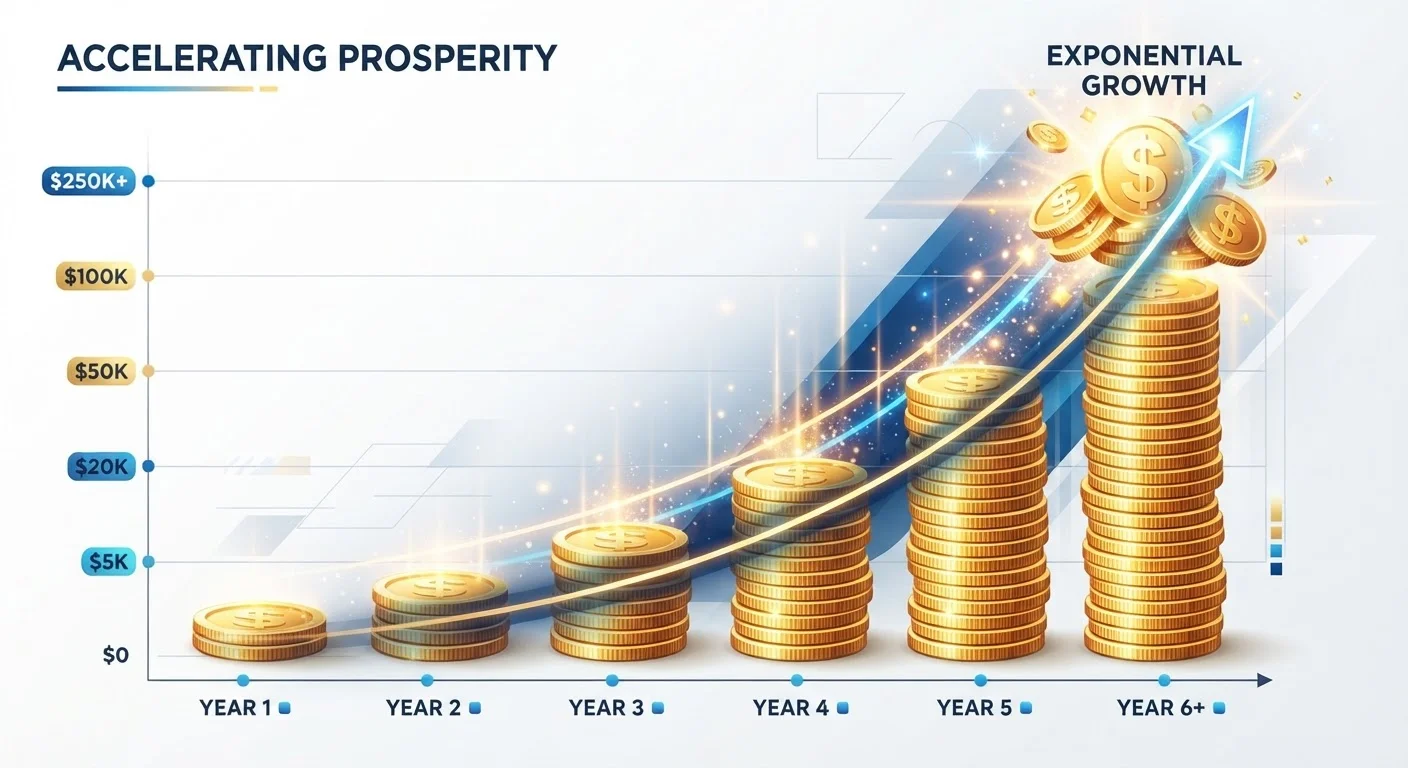
Photo credit: AdvisorHQ.net | Informative Website
In this article
Compound interest is one of the most powerful forces in personal finance. Here's how it works and why starting early changes everything.
Key Takeaways
- Compound interest grows your money faster than simple interest by earning returns on previous returns.
- Time is the most powerful variable in compounding - starting earlier matters more than contributing larger amounts later.
- Compound interest works against you in debt, not just for you in savings and investing.
- Regular contributions amplify compounding effects significantly over the long run.
- Consult a qualified financial adviser before making decisions based on your personal circumstances.
How Compounding Actually Works
The core mechanic is straightforward: instead of earning interest only on your starting balance, you earn interest on your balance plus all the interest accumulated to date. Each compounding period, that growing total becomes the new base for the next round of interest.
Consider a simplified illustration. If you deposit $1,000 at a 5% annual rate with simple interest, you earn $50 every year - always calculated on the original $1,000. After 20 years, you'd have $2,000. With compound interest at the same rate (compounded annually), your year-one interest is also $50, but in year two you earn 5% on $1,050 - not $1,000. The difference seems small at first, but after 20 years your balance grows to approximately $2,653. The gap widens dramatically over longer periods.
This is why compounding is often described as exponential growth rather than linear growth. The curve starts gently and then bends sharply upward - a pattern that rewards patience above almost everything else.
~$2,653
Value of $1,000 compounded annually at 5% over 20 years
Compared to $2,000 with simple interest at the same rate - a difference of over $650 from compounding alone.
72 ÷ Rate
Rule of 72: Years to double money
Divide 72 by the annual interest rate to estimate doubling time - e.g., at 6%, money roughly doubles in about 12 years. This is an approximation.
10+ Years
Early start advantage window
Financial educators commonly illustrate that starting contributions a decade earlier can outweigh contributing for a longer period starting later, due to compounding's time sensitivity.
Why Time Is the Most Critical Variable
No factor influences compounding outcomes more than time. A longer runway allows each dollar to compound through more cycles, and the gains in later years dwarf those in earlier ones - precisely because the base keeps growing.
This relationship between time and compounding is why many financial educators emphasize starting early over contributing large sums later. Someone who begins setting aside money at 25 and stops at 35 - a 10-year window - can end up with more than someone who starts at 35 and contributes for 30 straight years, depending on the rate of return. The early starter's contributions have decades more to compound.
That dynamic makes the decision to start saving or investing - and when - one of the most consequential in personal finance. Time already spent is the one resource that cannot be recovered.
Start Small, But Start Now
The most important compounding decision is simply beginning. A modest contribution made consistently over many years will, in most scenarios, outperform a larger contribution made later. Waiting for the 'right' amount to invest is one of the most common ways people lose the time advantage that compounding requires.
The Other Side of the Coin: Compounding on Debt
Compound interest is not inherently friendly. When you're a borrower rather than a saver, the same mechanics that build wealth can erode it. On revolving credit balances - such as credit cards - unpaid interest is typically added to the principal, and the next billing cycle charges interest on that larger amount.
This is why minimum payments on high-interest debt can feel like running in place. A large portion of each payment covers interest charges, leaving the principal nearly unchanged, and the compounding cycle continues. Understanding how compounding works against borrowers is essential for anyone managing credit card debt or personal loans.
Developing habits that keep debt manageable - such as paying more than the minimum and avoiding carrying balances month to month - directly limits how much compounding can work against you.
Making Compounding Work in Your Favor
Several principles help maximize the effect of compounding on the savings and investment side. First, consistency matters: regular contributions - even small ones - compound alongside original principal, accelerating the overall growth curve. Second, minimizing disruptions preserves the base that generates returns; withdrawing funds early interrupts the cycle.
Third, the rate of return interacts with time to produce dramatically different outcomes. A higher return on a long time horizon compounds into a vastly different figure than a lower return over the same period - which is why many financial educators discuss the relationship between common investing misconceptions and the importance of remaining invested rather than reacting to short-term market movements.
Finally, building the habit itself is foundational. Compounding rewards those who stick with a plan. Our guide on building a savings habit that sticks explores the behavioral and structural principles that make consistent saving sustainable over time.
This article is for general informational purposes only and does not constitute personalized financial, investment, tax, or legal advice. Consult a qualified financial adviser for guidance specific to your situation.
Frequently Asked Questions

Author
Finance Editorial Team
Finance Editorial Team is the collective byline for our editorial team and contributor network. Articles published under this byline or an editorial pen name are researched, written, and reviewed according to our editorial standards for clarity, consistency, and independence before publication.
View all articles →