
Risk and Return: Understanding the Trade-Off at the Heart of Investing
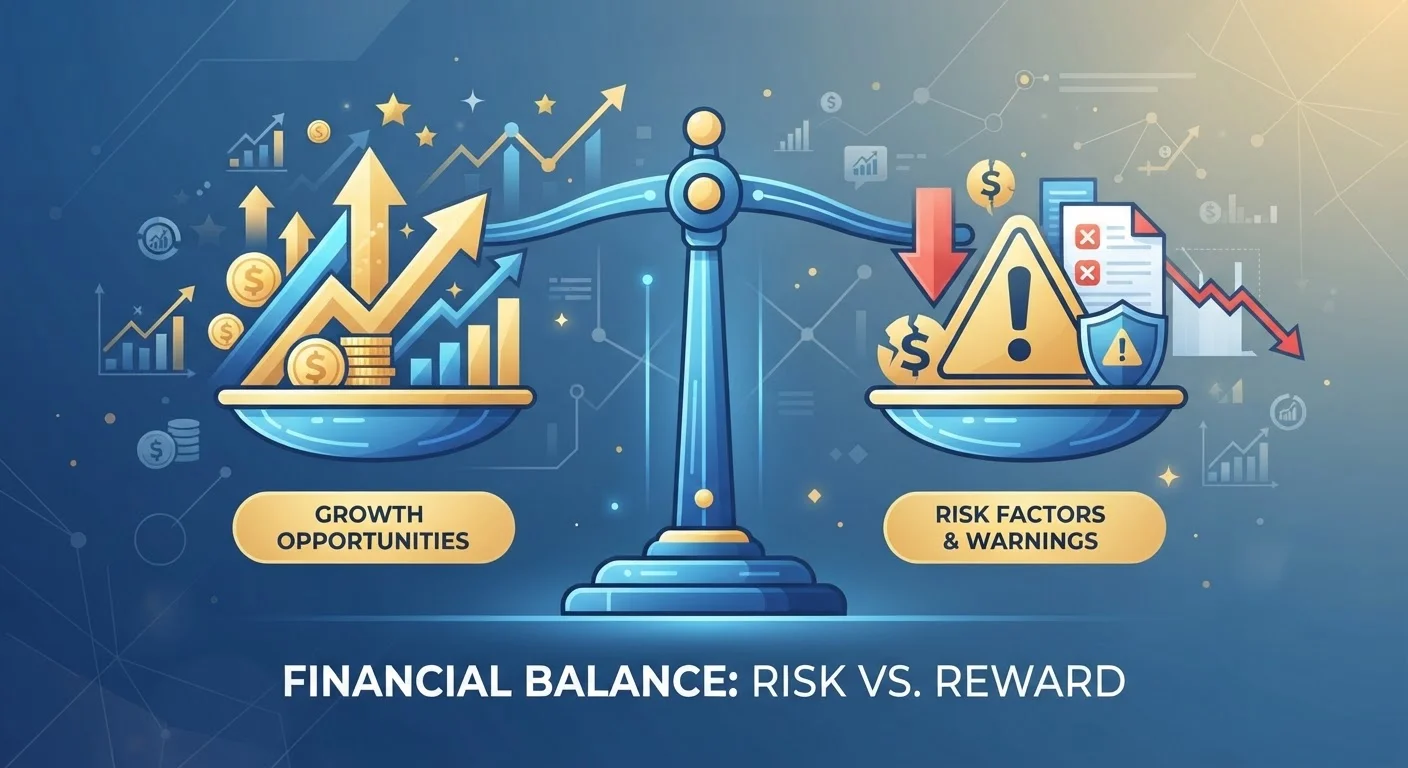
Photo credit: AdvisorHQ.net | Informative Website
In this article
Every investment involves risk. Learn what risk and return mean, how they relate, and why no investment is ever truly 'safe.'
Key Takeaways
- Higher potential returns almost always come with higher potential for loss.
- No investment is completely risk-free - even cash loses purchasing power to inflation.
- Risk tolerance is personal and depends on your timeline, goals, and financial situation.
- Diversification can help manage risk without necessarily sacrificing all return potential.
- Understanding risk types helps investors make more informed, deliberate decisions.
Why Risk and Return Are Inseparable
At its core, investing is an exchange: you commit money today in exchange for the possibility of more money tomorrow. The word possibility matters. There are no guarantees. The potential reward you might receive is directly connected to the uncertainty you accept - and that relationship is not accidental. It is built into how financial markets work.
When you deposit money in a federally insured savings account, you accept a lower return because you're taking on very little risk of losing your principal. When you buy shares in a single company, your potential upside grows, but so does the chance that the company underperforms, restructures, or fails. Markets price this uncertainty into returns automatically. Investors demand higher potential rewards to compensate for taking on more risk - and that demand shapes asset prices across the board.
This is why understanding the risk-return trade-off is foundational to any investing decision. It isn't a warning to avoid risk. It's a framework for making deliberate, informed choices about how much uncertainty you're willing to accept - and why. See our overview of saving vs. investing to understand where this trade-off begins.
Types of Risk Every Investor Should Know
Risk isn't a single, uniform concept. Several distinct types of risk affect investments differently, and recognizing them helps investors think more clearly about what they're actually accepting when they commit their money.
~10%
Average annual U.S. stock market return (historical)
The U.S. stock market has historically returned roughly 10% annually before inflation over the long run, according to data from major index providers - but with significant year-to-year variation and no guarantee of future performance.
34%
S&P 500 peak-to-trough decline in early 2020
During the COVID-19 market shock in early 2020, the S&P 500 fell approximately 34% in about five weeks, illustrating the short-term volatility investors accept in exchange for long-term return potential.
3-5%
Typical annual inflation range (U.S., recent years)
Inflation in the U.S. has run between roughly 3% and over 8% in recent years, according to Bureau of Labor Statistics data, underscoring why returns on low-risk cash holdings may not preserve purchasing power.
- Market risk (also called systematic risk): The risk that the overall market declines, pulling most investments down with it - regardless of how well a specific company is performing.
- Credit risk: The risk that a bond issuer - a corporation or government - fails to make interest payments or repay principal. Higher-yield bonds typically carry more credit risk.
- Inflation risk: The risk that investment returns don't keep pace with rising prices, eroding purchasing power over time. A 2% return in a 4% inflation environment is effectively a loss in real terms.
- Liquidity risk: The risk of not being able to sell an investment quickly without significantly affecting its price. Real estate, for example, is far less liquid than publicly traded stocks.
- Concentration risk: The danger of being overexposed to a single investment, sector, or asset class. This is the risk that diversification is specifically designed to address.
No investment escapes all of these risks simultaneously. The goal isn't to find a risk-free option - it's to understand which risks you're taking and whether the potential return justifies them.
How Different Asset Classes Reflect the Trade-Off
The risk-return trade-off plays out visibly across major asset classes. Cash and cash equivalents - savings accounts, money market funds, certificates of deposit - sit at the low-risk, low-return end of the spectrum. They offer stability and liquidity, but inflation can gradually erode their real value.
Bonds occupy a middle ground. Government bonds from stable economies carry relatively low credit risk, while corporate bonds - especially those rated below investment grade, sometimes called "high-yield" or "junk" bonds - offer higher potential returns alongside meaningfully higher risk of default.
Stocks historically have offered higher long-term returns than bonds or cash, but with substantially more short-term volatility. A portfolio of stocks can lose 30%, 40%, or more of its value during a market downturn before recovering. That recovery is not guaranteed on any particular timeline. Our guide to stocks, bonds, and cash explores these trade-offs in detail.
“Risk comes from not knowing what you're doing. The most important quality for an investor is temperament, not intellect.”
— Warren Buffett, Chairman and CEO, Berkshire Hathaway; widely recognized long-term value investor
This article is for general informational and educational purposes only and does not constitute personalized financial, investment, or tax advice. Consult a licensed financial professional before making decisions about your own investments.
Matching Risk to Your Personal Situation
Risk tolerance - the degree of uncertainty an investor can comfortably accept - varies significantly from person to person and isn't fixed over a lifetime. Two factors shape it most heavily: time horizon and financial capacity for loss.
An investor with decades before they need their money has more time to ride out market downturns and recover from short-term losses. Someone who needs funds within two years faces a very different situation - a sharp decline could be devastating if there's no time to wait for recovery. This is why conventional financial guidance generally suggests that the appropriate level of investment risk should decrease as a financial goal approaches, though individual circumstances always vary.
Financial capacity for loss matters equally. Someone with stable income, an emergency fund, and no immediate large expenses may be in a position to absorb more volatility than someone with tighter finances. Neither position is better or worse - they simply call for different approaches.
Common misconceptions about what's truly risky can complicate these decisions. Separating investing fact from fiction is an important step before making any significant financial commitment. Always consider speaking with a qualified financial adviser who can assess your full situation before making decisions.
Frequently Asked Questions

Author
Finance Editorial Team
Finance Editorial Team is the collective byline for our editorial team and contributor network. Articles published under this byline or an editorial pen name are researched, written, and reviewed according to our editorial standards for clarity, consistency, and independence before publication.
View all articles →