
Currency Exchange Myths That Cost Travelers Money
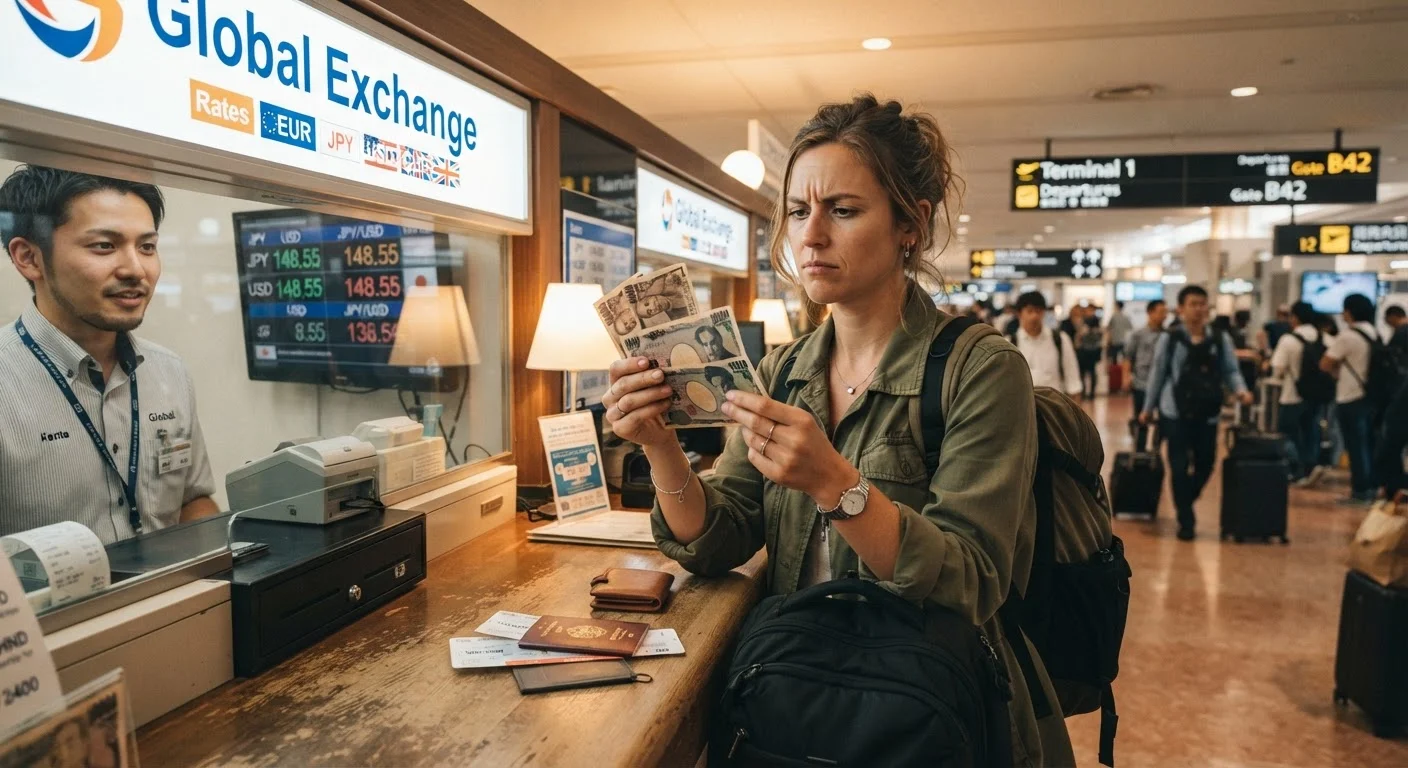
Photo credit: AdvisorHQ.net | Informative Website
In this article
Airport kiosks are always worst? Local ATMs are always safest? Common beliefs about exchanging money abroad don't always hold up.
Key Takeaways
- Airport exchange kiosks are generally costly, but a few exceptions exist depending on destination and competition.
- Local ATMs abroad are often reliable, but foreign transaction fees and ATM surcharges can erode any savings.
- Exchanging all your cash before departure is rarely necessary and sometimes gets you a worse rate.
- Dynamic currency conversion at point-of-sale is almost always the worse choice for the traveler.
- No single method works best everywhere - understanding your options puts more money in your pocket.
Why Currency Exchange Myths Are So Expensive
Few travel decisions feel as confusing as figuring out how to get local currency. Advice circulates freely - from well-meaning friends, outdated blog posts, and airport signage designed by the very businesses profiting from your uncertainty. The result: many travelers lose more money to avoidable fees than they ever do to petty theft or overpriced souvenirs.
The myths around currency exchange persist because there's a kernel of truth in almost every one of them. That makes them especially tricky. Understanding why a piece of conventional wisdom exists - and where it breaks down - is far more useful than a simple rule. For a broader look at how hidden costs sneak into travel budgets, see our guide to hidden travel costs.
Myth
Airport currency exchange kiosks always offer the worst rates, so you should never use them.
Fact
Airport kiosks are usually expensive, but "always worst" overstates it - rates vary by airport, currency pair, and how much competition exists nearby.
The "never use the airport" rule is sound general advice, but it's not a universal law. In some smaller international airports, the kiosk on-site may charge only marginally more than in-city bureaux de change, especially for less-traded currencies where the market is thin regardless of location. The real lesson is to compare rates before you commit - not to assume any single venue is always the worst. If you genuinely have no local currency upon arrival and need bus fare or a taxi, a small transaction at the airport won't ruin your trip. Just don't exchange large sums there reflexively.
Myth
Using a local ATM abroad always gives you the best exchange rate.
Fact
Local ATMs often use competitive interbank-adjacent rates, but your home bank's foreign transaction fees and the ATM operator's own surcharges can wipe out that advantage.
ATMs in your destination country typically pull a rate close to the interbank rate - which is genuinely good. The problem is the fee stack that piles on top. Your U.S. bank may charge a flat international withdrawal fee (often $3-$5) plus a percentage-based foreign transaction fee (commonly 1-3%). The ATM operator may add its own surcharge on top. On a small withdrawal, those fixed fees represent a surprisingly large percentage of the total. The solution isn't to avoid ATMs - it's to withdraw larger amounts less frequently, and to use accounts from financial institutions that reimburse or waive international ATM fees.
Myth
You should exchange all your travel cash at home before departure to get a better rate.
Fact
Exchanging everything at home is convenient, but the rates offered domestically for foreign currency are often no better - and sometimes worse - than options at your destination.
U.S. banks and exchange services frequently charge a premium for physical foreign currency because they have to source and hold it. The rate you get converting dollars to euros at your local bank branch may actually be less favorable than using a fee-free card or a reputable ATM once you arrive. Exchanging a modest amount before departure for immediate arrival needs (transportation, a meal) is perfectly reasonable. Exchanging your entire travel budget at home out of anxiety is rarely the financially optimal move.
Myth
When a merchant offers to charge you in U.S. dollars instead of local currency, you should accept - it's simpler.
Fact
This practice, called dynamic currency conversion (DCC), almost always gives you a worse exchange rate and should be declined in favor of paying in the local currency.
Dynamic currency conversion is a legitimate-sounding service that lets you see your charge in dollars at the point of sale. What it doesn't advertise is that the merchant or payment processor sets the conversion rate - and it typically includes a significant markup over the rate your card network would apply. Studies of DCC transactions have consistently found the rates to be materially worse for the consumer. When a card terminal or ATM asks whether you want to pay in your home currency or the local currency, always choose local currency and let your card network handle the conversion.
Myth
Carrying traveler's checks is a smart, safe backup for international travel.
Fact
Traveler's checks have become difficult to cash in many destinations and often come with fees and inconvenient acceptance, making them a poor primary backup strategy for most travelers today.
Traveler's checks were once the gold standard of safe travel money - insured, replaceable if lost, and widely accepted. That era has largely passed. Many hotels, banks, and businesses abroad have stopped accepting them, and those that do may charge fees or offer unfavorable conversion rates. For most travelers today, a combination of a fee-friendly debit or credit card plus a modest cash reserve serves the same security purpose with far greater practicality. If you're traveling somewhere with genuinely unreliable ATM infrastructure, research destination-specific guidance from current traveler communities rather than defaulting to traveler's checks.
Practical Principles for Smarter Exchanges
Once you've cleared away the myths, a few durable principles emerge. First, always know the mid-market exchange rate before you travel - it's freely available on any currency converter and serves as your baseline benchmark. Any rate you're offered will be worse than this; the question is by how much.
Second, minimize the number of currency conversions you make. Every conversion is a fee event. If you're passing through multiple countries with different currencies, plan your cash needs deliberately rather than reactively exchanging leftover bills at each border.
Watch for 'No Commission' Claims
Exchange services that advertise 'zero commission' or 'no fees' frequently recover their profit through a wider spread between the buy and sell rates - meaning the exchange rate itself is worse. There is no free currency exchange; the cost is always built in somewhere. Always compare the rate you're being offered against the current mid-market rate, regardless of what the fee signage says.
Third, watch your cards as closely as your cash. Some credit cards charge no foreign transaction fees and use rates close to the mid-market rate - but others tack on 2-3% per purchase. Knowing which cards you're carrying before departure is as important as knowing the local exchange rate. For similar myth-busting on financial decisions closer to home, our article on credit myths that cost people real money is worth a read.
Finally, keep a small cushion of local cash for vendors, taxis, and markets that don't accept cards - but resist the urge to carry large amounts. The peace of mind isn't worth the exchange cost on currency you may never spend.

Author
Travel & Trips Editorial Team
Travel & Trips Editorial Team is the collective byline for our editorial team and contributor network. Articles published under this byline or an editorial pen name are researched, written, and reviewed according to our editorial standards for clarity, consistency, and independence before publication.
View all articles →