
Credit Myths That Cost People Real Money
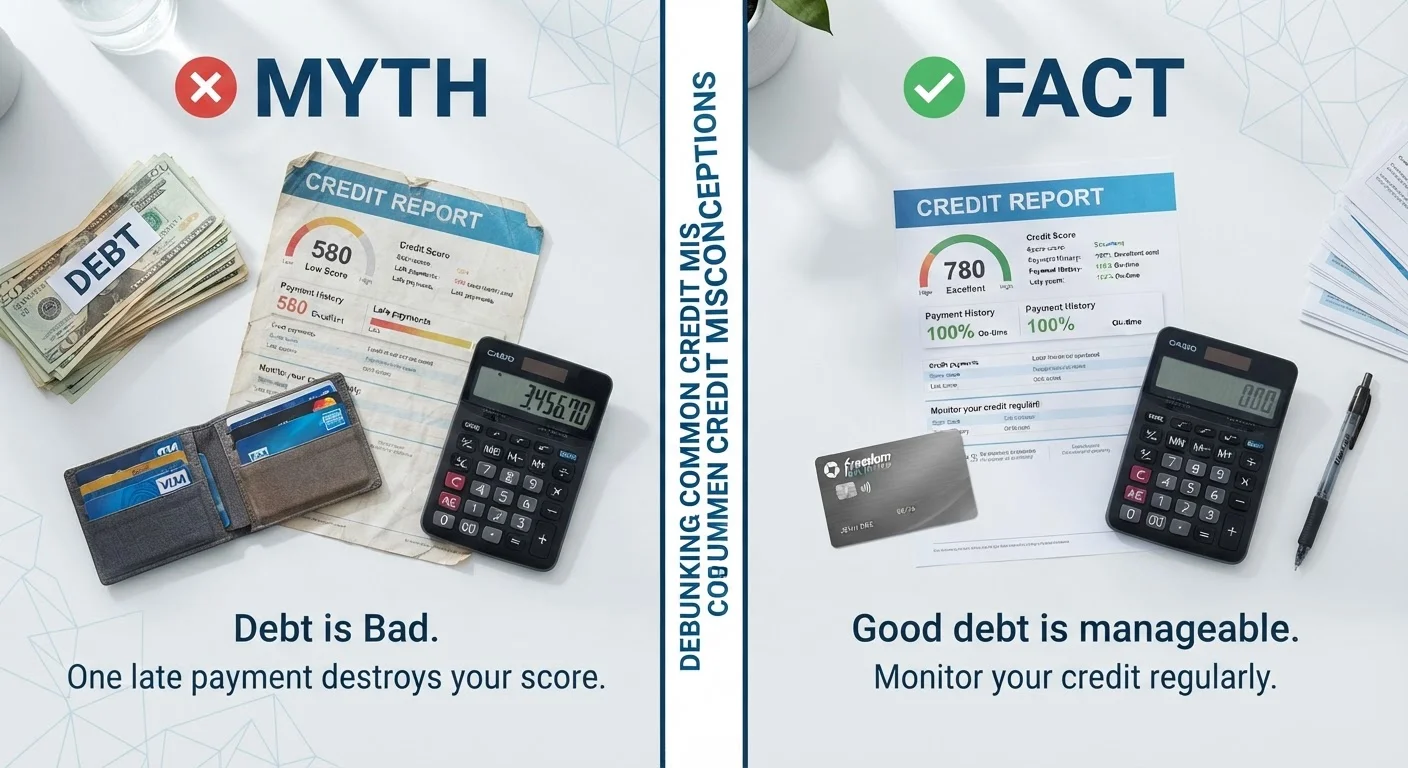
Photo credit: AdvisorHQ.net | Informative Website
Closing old cards boosts your score. Checking your own credit hurts it. These common beliefs are wrong—here's the truth.
Key Takeaways
- Checking your own credit score never hurts it - only hard inquiries from lenders do.
- Closing old credit cards can actually lower your score by reducing available credit.
- Carrying a monthly balance does not build credit and costs you money in interest.
- A single missed payment can remain on your credit report for up to seven years.
- Income has no direct bearing on your credit score calculation.
Why Credit Myths Are Financially Dangerous
Credit scores silently influence some of the largest financial decisions in a person's life - mortgage approvals, auto loan rates, even apartment applications. Yet a surprising number of Americans operate on beliefs about credit that are simply incorrect. Acting on those beliefs can mean paying higher interest rates, getting denied for loans, or inadvertently damaging the score they were trying to protect.
This article corrects the most widely held credit misconceptions, grounded in how scoring models - primarily FICO and VantageScore - actually work. For a deeper foundation on what a credit score is and how it's calculated, see Credit Scores Explained: What the Number Actually Means.
This article is for general informational purposes only and does not constitute personalized financial or legal advice. Consult a qualified financial professional for guidance specific to your situation.
Myth
Checking your own credit score will lower it.
Fact
Checking your own credit is a 'soft inquiry' and has no effect on your score whatsoever.
Credit inquiries come in two types. A hard inquiry occurs when a lender pulls your report to evaluate a credit application - this can temporarily lower your score by a few points. A soft inquiry occurs when you check your own credit, or when a lender pre-screens you for an offer. Soft inquiries are invisible to scoring models and cause no score impact. Avoiding self-checks out of fear means missing errors or fraudulent accounts that could be silently damaging your profile.
Myth
Closing old credit cards improves your credit score.
Fact
Closing old accounts typically hurts your score by reducing available credit and shortening your credit history.
Two scoring factors work against you when you close an old card. First, your credit utilization ratio - balances divided by total available credit - rises if you remove a card with available credit, which signals higher risk to lenders. Second, the average age of your accounts, a component of the length-of-credit-history factor, can decrease over time once an account closes. Older accounts with no annual fee are generally worth keeping open, even if rarely used.
Myth
Carrying a small balance each month builds credit faster.
Fact
Paying your balance in full each month builds credit just as effectively - and saves you money in interest.
This myth likely stems from a misunderstanding of what lenders want to see. Scoring models reward on-time payments and low utilization - neither of which requires carrying a balance. A balance that rolls over from month to month accrues interest at often high annual percentage rates (APRs), costing real money for no scoring benefit. Paying the statement balance in full each cycle demonstrates responsible usage without the interest expense.
Myth
A high income automatically means a high credit score.
Fact
Income is not a factor in any standard credit scoring model.
FICO and VantageScore calculate scores using credit behavior data from your credit report - payment history, debt levels, account age, types of credit, and recent applications. Income figures do not appear in credit reports and therefore play no role in your score. A high earner who pays bills late and carries high balances can have a low score, while someone with a modest income and disciplined credit habits can have an excellent one. Lenders may consider income separately when making lending decisions, but that is distinct from the credit score itself.
Myth
Missing one payment is no big deal - it barely affects your score.
Fact
A single missed payment can significantly damage your score and stay on your report for up to seven years.
Payment history is the single largest factor in most scoring models, accounting for roughly 35% of a FICO score. A payment that is 30 or more days late is reported to credit bureaus and can cause a notable score drop - the higher the starting score, the more dramatic the fall can be. That derogatory mark remains on your report for up to seven years, affecting lending decisions throughout that period. If a payment has been missed recently, acting quickly matters - the timeline and options after a missed payment are worth understanding immediately.
Myth
You only have one credit score.
Fact
You have multiple credit scores, calculated by different models and bureaus, which can vary meaningfully.
The three major credit bureaus - Equifax, Experian, and TransUnion - maintain separate files on you, and each can hold slightly different data depending on which creditors report to which bureau. Beyond that, multiple scoring models exist: different versions of FICO, VantageScore, and industry-specific scores used by auto lenders or mortgage underwriters. The score a lender sees may differ from the one you checked last week. Monitoring reports from all three bureaus annually (free at AnnualCreditReport.com) gives the most complete picture.
The Hidden Costs of Getting Credit Wrong
Believing these myths doesn't just leave knowledge gaps - it produces real financial consequences. Someone who closes old accounts to "tidy up" their credit profile may unintentionally spike their credit utilization ratio (the percentage of available credit they're using), which is one of the most sensitive scoring factors. To understand exactly how that ratio works, Credit Utilization: The Ratio That Quietly Moves Your Score provides a thorough breakdown.
Similarly, someone who believes carrying a small balance signals financial responsibility will pay unnecessary interest charges every month for a benefit that doesn't exist. And anyone who avoids checking their own credit out of fear of damage is flying blind - potentially missing errors or signs of identity theft that could be quietly dragging their score down.
Errors on Credit Reports Are More Common Than Most Realize
Studies have found that a notable share of consumer credit reports contain errors significant enough to affect creditworthiness. Under the Fair Credit Reporting Act, you have the right to dispute inaccurate information with credit bureaus at no cost. Regularly reviewing your reports from all three major bureaus is the only way to catch and correct mistakes before they affect a loan decision.
The five factors that actually shape a FICO score - payment history, amounts owed, length of credit history, new credit, and credit mix - are well-documented and publicly available. Decisions that work against any of these factors cost money, often in ways that aren't visible until a loan application is declined or an interest rate comes back higher than expected. For a precise look at how each factor is weighted, The Five Factors That Shape Your Credit Score is worth reading before making any major credit decisions.
35%
Weight of payment history in a FICO score
According to FICO's published scoring model breakdown, payment history is the single largest factor determining your credit score.
7 years
How long a missed payment stays on your credit report
Under the Fair Credit Reporting Act (FCRA), most negative items, including late payments, can remain on a consumer credit report for up to seven years.
Understanding what's true about credit is also inseparable from understanding debt. If you're wondering whether the debt you carry is working for or against you, Good Debt vs. Bad Debt: Is the Distinction Actually Useful? offers a more nuanced framework than the oversimplified labels most people use.

Author
Finance Editorial Team
Finance Editorial Team is the collective byline for our editorial team and contributor network. Articles published under this byline or an editorial pen name are researched, written, and reviewed according to our editorial standards for clarity, consistency, and independence before publication.
View all articles →