
Time Blocking, Task Lists, and Time Boxing: Which Approach Fits Which Work Style
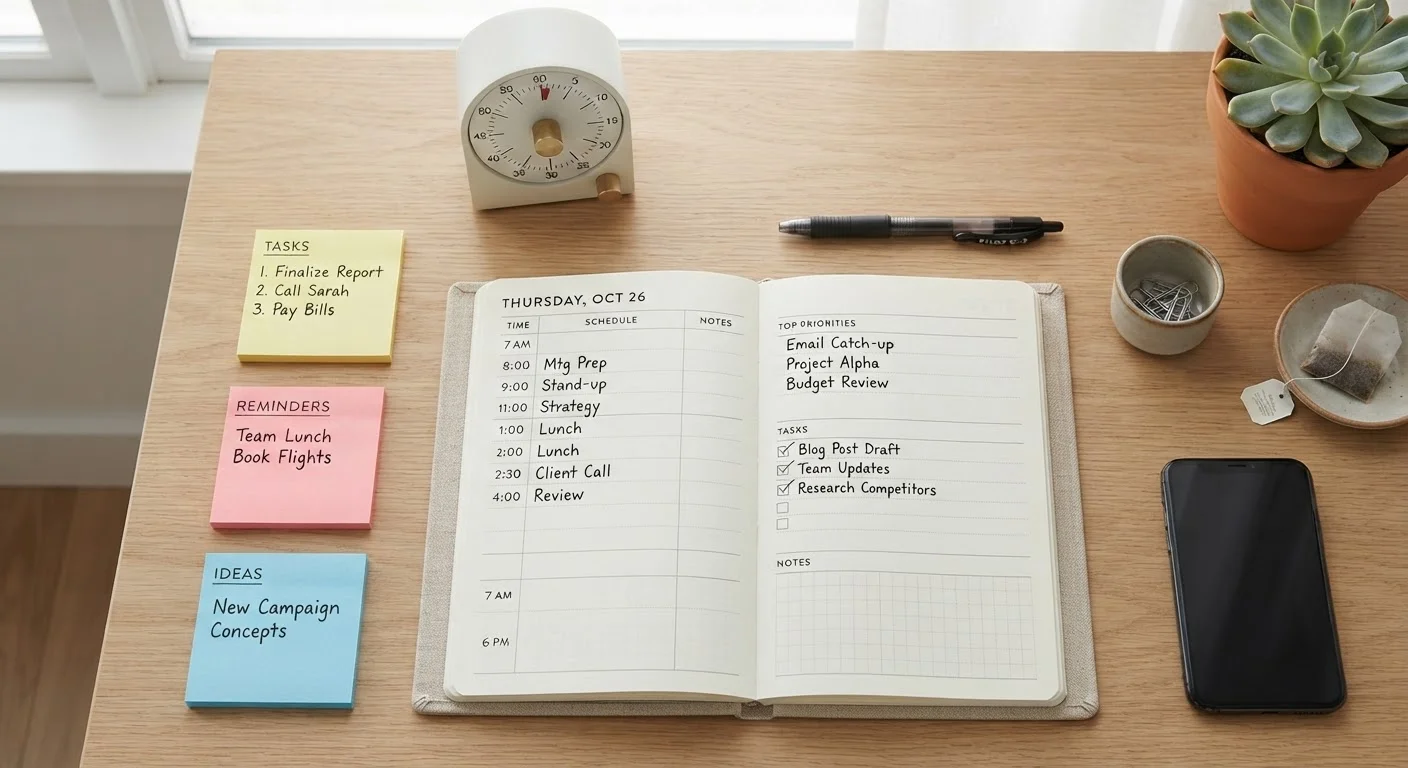
Photo credit: AdvisorHQ.net | Informative Website
In this article
Three popular productivity methods, each with different strengths. Understand how they work so you can choose the one that fits how you actually think.
Key Takeaways
- Time blocking assigns specific calendar slots to types of work, reducing decision fatigue throughout the day.
- Task lists are flexible and low-overhead but can create false productivity if not paired with prioritization.
- Time boxing sets a fixed deadline for a task whether or not it's finished, which drives faster decisions.
- Your work style, job type, and level of schedule control should guide which method you use.
- Hybrid approaches - combining two methods - often outperform any single system used rigidly.
What Each Method Actually Means
These three terms get used interchangeably in productivity circles, but they describe meaningfully different behaviors.
Task lists are the oldest and most familiar approach: you write down what needs to get done and work through items one by one. The list itself has no time dimension - it's a catalog, not a schedule.
Time blocking means assigning specific blocks of calendar time to categories of work. You might reserve 8-10 a.m. for deep analytical work, 10-11 a.m. for email, and 2-3 p.m. for meetings. The block belongs to a type of work, not necessarily a single task. Cal Newport, whose writing on deep work has influenced how many professionals think about focus, describes time blocking as a way to make deliberate decisions about where attention goes rather than reacting to whatever demands it first.
Time boxing is a cousin of time blocking but task-focused rather than work-type focused. You assign a fixed window to a specific task - say, 45 minutes to draft a proposal - and when the timer runs out, you stop and move on, finished or not. It's widely used in software development (sprint-based work borrows from this logic) and is particularly effective at preventing tasks from expanding to fill available time, a pattern sometimes called Parkinson's Law.
Understanding how these three differ is the first step in choosing the right fit for your situation.
Strengths and Weaknesses Side by Side
Each method has genuine advantages - and real failure modes. The comparison below maps out what matters most when choosing between them.
| Task Lists | Time Blocking | Time Boxing | |
|---|---|---|---|
| Core mechanism | Catalog of to-dos worked through flexibly | Calendar slots assigned to work types | Fixed time window per specific task |
| Setup effort | Very low | Medium to high | Low to medium |
| Best for | Varied, reactive workloads | Deep-focus, predictable schedules | Perfectionists and procrastinators |
| Key risk | List grows without real prioritization | Breaks down under unpredictable interruptions | Requires accurate time estimation |
| Schedule control needed | Low | High | Medium |
| Works well with remote work | Yes | Yes - especially async roles | Yes - enforces pace without supervision |
Task lists fail most predictably when they grow unchecked. A list of 30 items with no prioritization logic provides the feeling of organization without actually deciding what matters. Research on goal-setting consistently shows that specificity - when and how, not just what - dramatically improves follow-through.
Time blocking, on the other hand, demands a relatively stable schedule. If your day is frequently disrupted by urgent requests, incoming crises, or a manager who drops priorities without warning, rigid blocks become a source of frustration rather than focus. For some roles - particularly in customer-facing or reactive environments - a looser structure is simply more realistic. See how workplace environment intersects with productivity in our look at remote vs. office work research.
Time boxing's weakness is that it requires you to estimate how long tasks will take - a skill most people significantly underestimate at first. Studies on planning fallacy, a well-documented cognitive bias, suggest people routinely underestimate task duration even when they've done similar work before. Building in buffer time and adjusting estimates over weeks of practice helps correct this.
Which Work Style Fits Which Method
Test Your Method Against Your Real Day
Before committing to a new system, track how your time actually gets spent for three days without changing anything. Most people discover their real schedule looks very different from their intended one. That gap tells you which method addresses your actual problem rather than an idealized version of your workday.
Your job type and personal tendencies matter more than productivity influencer preferences when choosing a method.
Choose time blocking if: You do knowledge-intensive work that requires sustained concentration (writing, coding, analysis, design). You have meaningful control over your calendar. You find yourself constantly interrupted because you never said no to ad-hoc requests. Blocking creates a visible, defensible structure that makes it easier to decline interruptions without explanation.
Choose task lists if: Your work is inherently varied and reactive - support roles, office managers, small business owners juggling multiple hats. Lists are low-friction and portable. The key is pairing them with a prioritization system (such as labeling by urgency and importance) rather than using them as a raw dump of everything on your mind.
Choose time boxing if: You're a perfectionist who over-polishes work. You procrastinate on tasks until pressure forces action. You frequently underestimate how long things take and want to build better calibration. The fixed endpoint reduces the paralysis of open-ended effort.
Many people find that their delegation habits interact with their planning method - if you struggle to hand off work, your task list stays bloated regardless of the system. Our piece on why smart professionals struggle to delegate explores that layer separately.
There's also a meaningful overlap between scheduling your work and scheduling your life. If work-life boundaries are part of your challenge, the principles in work-life balance vs. integration apply directly to how any of these methods gets implemented.
Building a Hybrid Approach That Actually Sticks
In practice, the most durable productivity systems combine elements from more than one method. A simple hybrid that works for many knowledge workers:
- Maintain a prioritized task list as your source of truth - everything lives there, ranked by importance not just urgency.
- Use time blocks to protect your highest-value focus periods in the morning, before reactive work crowds the day.
- Apply time boxing to specific tasks within those blocks when you know you're prone to over-engineering or stalling.
The point isn't to follow a system perfectly - it's to reduce the number of decisions you make in real time about what to do next. Every time you have to stop and ask yourself "what should I work on now?" you lose momentum and invite distraction.
Start with whichever method creates the least friction given your current role. Run it for two to three weeks before judging it. Most people abandon systems prematurely because they feel uncomfortable, not because the method is actually wrong for them. Adjusting is fine; wholesale abandonment after three days isn't a fair test.
For those managing their professional environments - home office or otherwise - structured thinking about how your physical space supports your chosen method can also matter. The principle of organizing around how you actually work, rather than how you think you should work, applies equally to schedules and spaces. See how that thinking plays out in zone-based room organization.

Author
Work & Business Editorial Team
Work & Business Editorial Team is the collective byline for our editorial team and contributor network. Articles published under this byline or an editorial pen name are researched, written, and reviewed according to our editorial standards for clarity, consistency, and independence before publication.
View all articles →