
Synthetic vs. Conventional Motor Oil: Choosing the Right Fit for Your Engine
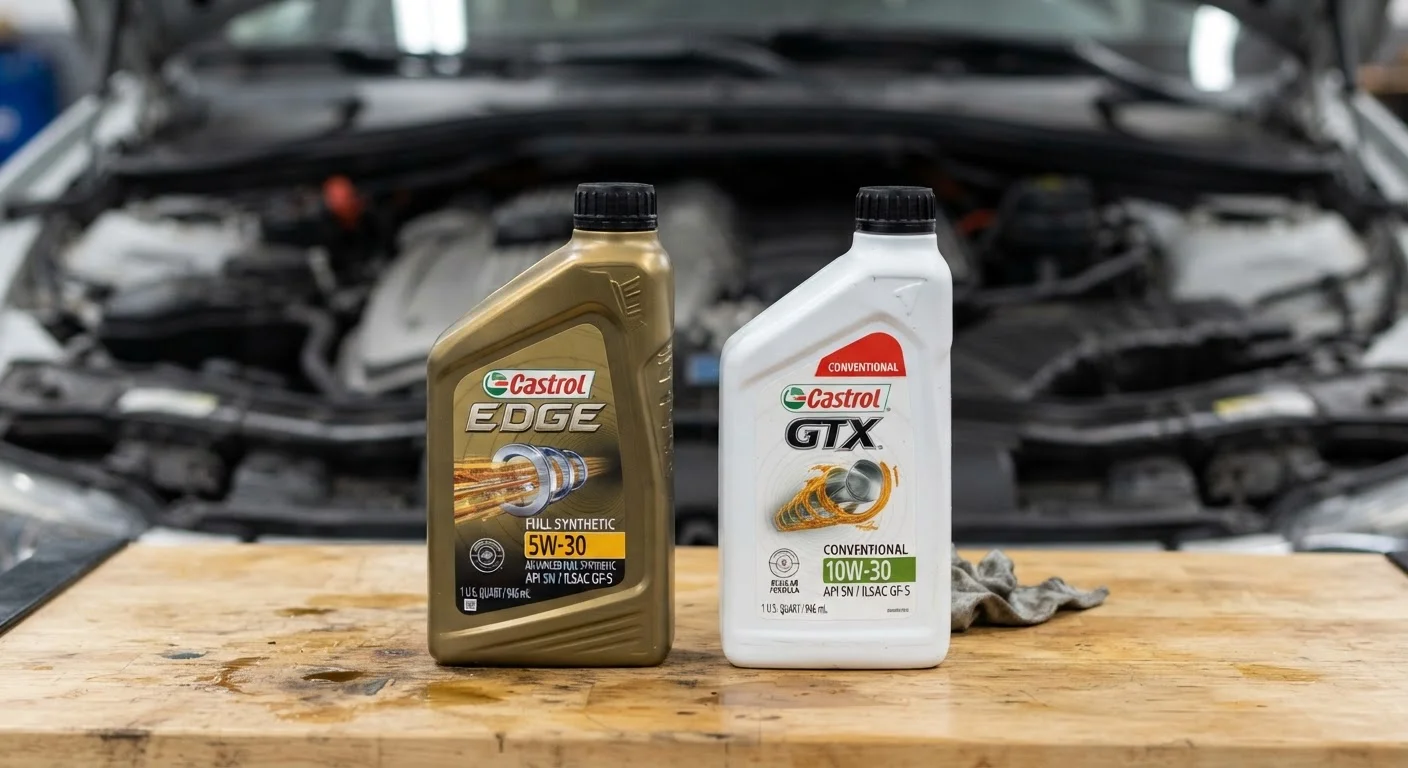
Photo credit: AdvisorHQ.net | Informative Website
In this article
A clear side-by-side look at how synthetic and conventional motor oils differ in performance, longevity, and everyday driving scenarios.
Key Takeaways
- Synthetic oil is refined and chemically engineered for more consistent molecular structure, offering greater stability under stress.
- Conventional oil comes directly from refined crude oil and contains natural impurities that break down more quickly under heat.
- Your vehicle's owner's manual is the definitive source for which oil type your engine requires.
- Synthetic oil typically allows longer change intervals, but this varies by vehicle, driving conditions, and manufacturer guidelines.
- Switching from conventional to synthetic in a high-mileage engine should be done carefully and ideally with a mechanic's input.
- Neither oil type automatically beats the other - the right choice depends on your specific engine and driving demands.
What Actually Separates These Two Oil Types
At their core, both synthetic and conventional motor oils serve the same fundamental purpose: lubricating your engine's moving parts to reduce friction, manage heat, and carry away contaminants. The key difference lies in how each oil is made and how it behaves once it's inside your engine.
Conventional motor oil is derived directly from refined crude oil. While the refining process removes many impurities, naturally occurring wax molecules and other irregularities remain. These inconsistencies in molecular structure mean the oil can break down more quickly, especially under high temperatures or sustained heavy use.
Synthetic motor oil is either highly refined conventional oil or purpose-built from chemical compounds in a laboratory. The result is a more uniform molecular structure with fewer impurities. This consistency allows synthetic oil to maintain its protective properties across a wider range of temperatures and for longer periods between changes.
It's worth noting that a third category - synthetic blend oil - mixes both types and is often positioned as a middle-ground option. However, this comparison focuses on the two primary categories most drivers encounter.
| Criterion | Synthetic Motor Oil | Conventional Motor Oil |
|---|---|---|
| Origin | Chemically engineered or highly refined | Refined directly from crude oil |
| Molecular consistency | Highly uniform, fewer impurities | Natural variation, more impurities |
| Cold-weather performance | Flows quickly at low temperatures | Can thicken in cold conditions |
| Heat resistance | Strong stability under sustained heat | Breaks down faster at high temps |
| Typical change interval | Often 7,500-15,000 miles (varies by vehicle) | Often 3,000-5,000 miles (varies by vehicle) |
| Cost per quart | Higher upfront cost | Lower upfront cost |
| Best engine fit | Modern, turbocharged, high-performance | Older, simpler, moderate-use engines |
| Environmental impact | Fewer changes may mean less waste oil | More frequent disposal of used oil |
Performance and Protection: How Each Oil Holds Up
One of the most practical distinctions between these oil types shows up in real-world engine conditions. Synthetic oil's molecular consistency gives it a clear advantage in several scenarios:
- Cold-weather starts: Synthetic oil flows more easily at low temperatures, reaching critical engine parts faster during cold starts - a period when much of the engine wear in a vehicle's lifetime actually occurs.
- High-heat stability: Under sustained heat - from a turbocharged engine, towing, or stop-and-go traffic - synthetic oil resists thinning and oxidation better than conventional oil.
- Extended change intervals: Because synthetic oil degrades more slowly, many manufacturers allow longer intervals between changes when using it. Always verify this in your owner's manual rather than assuming a universal interval applies. For a deeper look at what those intervals actually mean, see our guide to oil change intervals.
Conventional oil, while effective for many engines, requires more frequent changes to maintain adequate protection. It remains a viable choice for vehicles whose manufacturers permit it and whose drivers stay current with maintenance schedules. The idea that you must change oil every 3,000 miles regardless of oil type is largely outdated - common maintenance myths like this one are worth examining carefully.
~40%
Of engine wear occurring at cold startup
Industry engineers have long noted that a significant portion of cumulative engine wear occurs during the first moments after starting, before oil fully circulates - an area where synthetic oil's flow properties offer a measurable advantage.
2-4×
Typical cost difference per quart
Synthetic motor oil generally costs two to four times more per quart than conventional oil at retail, though longer change intervals can partially offset this over time depending on the vehicle.
70%+
New U.S. vehicles specifying synthetic oil
The shift toward turbocharged, fuel-efficient engines in modern vehicle design has led the majority of new passenger vehicles sold in the United States to call for synthetic or synthetic-blend oil per manufacturer specifications.
Cost, Compatibility, and Making the Right Call
Synthetic oil typically costs more per quart than conventional oil - often two to four times as much at the point of purchase. However, when factoring in longer change intervals (where your vehicle supports them), the overall cost difference over time may narrow considerably. The calculation depends heavily on your specific vehicle, mileage, and driving habits.
Compatibility is an equally important consideration. Many modern engines, particularly those with turbochargers or direct injection systems, are specifically engineered to run on synthetic oil. Using conventional oil in these engines may void your warranty or accelerate wear. Your owner's manual is non-negotiable on this point - it specifies both the oil type and viscosity grade your engine requires.
For older or high-mileage engines, the decision warrants extra care. Some aging seals may respond poorly to abrupt oil-type changes. If you're unsure, consult a qualified mechanic before switching. Knowing when to handle maintenance yourself and when to seek professional help is a skill that pays off over the life of any vehicle.
Ultimately, there is no universally superior choice between these two oil types - only the right choice for your engine, your climate, and your driving patterns. Start with what your manufacturer specifies, and let that be your baseline.

Author
Cars & Driving Editorial Team
Cars & Driving Editorial Team is the collective byline for our editorial team and contributor network. Articles published under this byline or an editorial pen name are researched, written, and reviewed according to our editorial standards for clarity, consistency, and independence before publication.
View all articles →