
Driving at Night: Why Your Eyes Aren't as Reliable as You Think
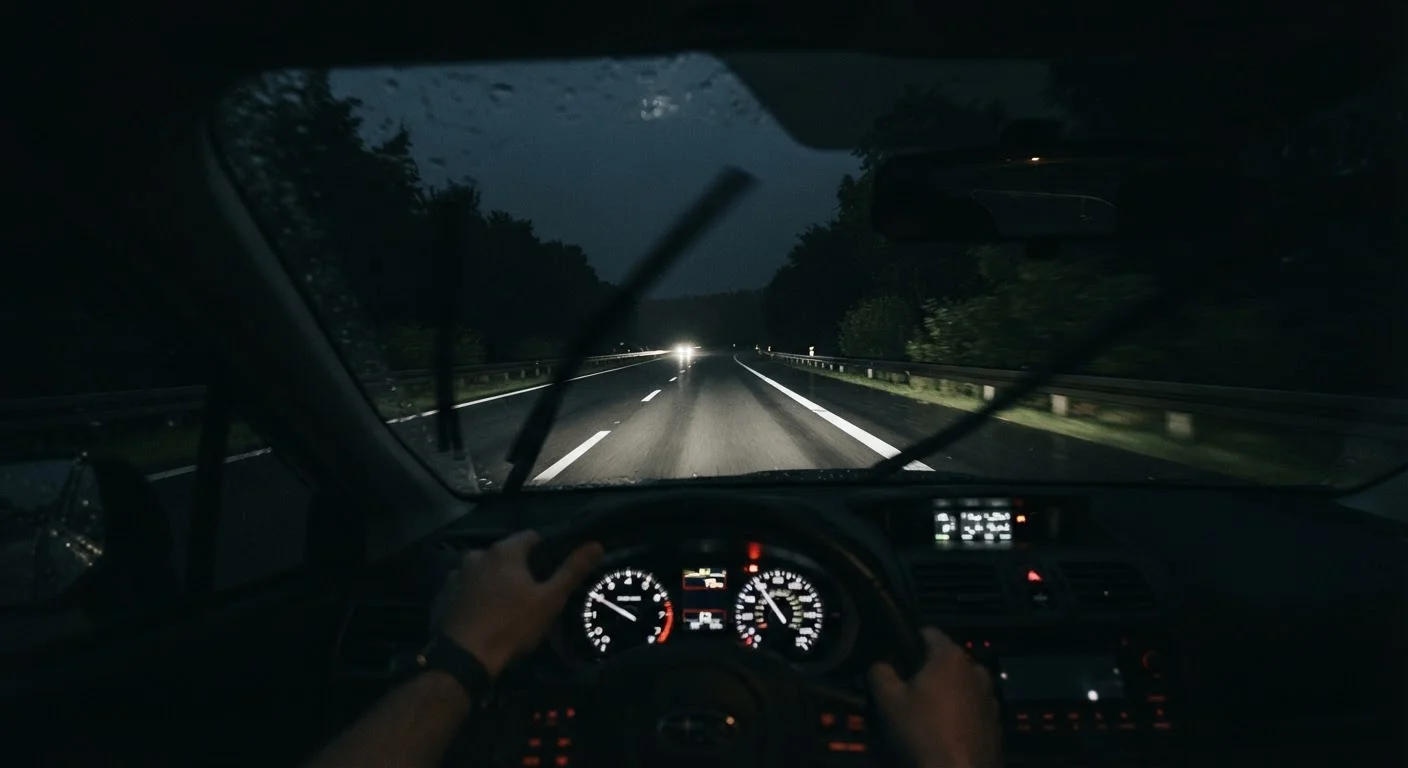
Photo credit: AdvisorHQ.net | Informative Website
In this article
Darkness changes how your eyes process speed, distance, and contrast. Understand the science behind night driving risks and how to compensate.
Key Takeaways
- Human eyes lose significant depth perception and contrast sensitivity after dark.
- Standard headlights illuminate far less road than the distance needed to stop at highway speeds.
- Older drivers face steeper night vision challenges due to natural changes in the eye.
- High-beam use is widely underutilized, even when road conditions clearly warrant it.
- Fatigue and night driving compound each other, increasing crash risk substantially.
How Darkness Physically Alters Your Vision
Your eyes rely on two types of photoreceptors: cones, which handle color and fine detail in bright light, and rods, which take over in dim conditions. At night, rods dominate - but they come with real limitations. Rods are concentrated away from the center of the retina, which means your sharpest daytime focus point becomes one of your weakest night-vision areas. Looking slightly to the side of an object in dim light can actually help you see it more clearly than staring directly at it.
Beyond receptor shift, your pupils dilate in darkness to allow more light in - but this also reduces depth of field, making it harder to judge distances accurately. Contrast sensitivity, your ability to distinguish objects from their backgrounds, drops substantially at night. A pedestrian in dark clothing against a shadowed roadside may be nearly invisible to your eyes even when they are well within your legal field of view.
These are not quirks or failures - they are normal physiological responses. But they do mean that nighttime driving places demands on your visual system that daytime driving simply does not. Understanding these limits is the first step toward compensating for them safely.
Common Myths About Night Driving - Corrected
Misconceptions about night driving are widespread, and many are genuinely dangerous because they lead drivers to overestimate their own capabilities. The myth-and-fact pairs below address the most consequential of these beliefs.
Myth
My eyes adjust to darkness quickly, so night driving isn't much different after a few minutes.
Fact
Full dark adaptation takes up to 30 minutes and is never as capable as daylight vision, regardless of how long you've been driving.
The initial adjustment from bright to dim light is rapid, but full dark adaptation - the process of the rods reaching peak sensitivity - takes considerably longer. More importantly, even fully adapted night vision offers reduced acuity, poorer contrast detection, and virtually no color discrimination compared to daytime. A few minutes in the dark does not restore your daytime visual capability; it only brings your night vision to its best possible (but still limited) state.
Myth
If I can see well enough to drive safely in the day, I can see well enough at night too.
Fact
Daytime visual acuity does not predict night vision quality - the two depend on different physiological systems.
Standard vision tests, including those used for driver's license renewals, are typically conducted in well-lit conditions and measure cone-based acuity. Night vision depends largely on rod function, pupil dilation capacity, and the eye's ability to process low-contrast scenes - none of which are captured by a standard eye chart. A driver with excellent daytime vision may have meaningfully worse-than-average night vision and not know it.
Myth
High beams are only necessary on very remote roads - on normal roads, low beams are fine.
Fact
High beams are appropriate on any unlit road without oncoming traffic, and many drivers underuse them in conditions where they would significantly improve visibility.
Many drivers reserve high beams for only the darkest rural environments, when in fact any road without sufficient ambient lighting - including suburban roads and highways with no streetlights - can benefit from high-beam use. The critical rule is to dim them when oncoming traffic or a leading vehicle is present, as required by law in all U.S. states. Beyond that, high beams can effectively double your sight distance, giving you substantially more time to react to hazards ahead.
Myth
Driving at the speed limit at night is always safe, since limits account for all conditions.
Fact
Posted speed limits are legal maximums set for typical daytime conditions - not safe speeds for all nighttime scenarios.
Speed limits reflect a range of considerations, including road design and traffic flow, but they are not calibrated for reduced visibility, wet pavement, or driver fatigue. At night, especially on unlit roads, traveling at the posted limit may mean overdriving your headlights - moving faster than your sight distance allows you to stop safely. Safe speed at night often means deliberately choosing a pace below the posted limit based on actual conditions.
Myth
Oncoming headlights are just a minor annoyance - your vision recovers almost instantly.
Fact
Glare from oncoming headlights can impair your vision for several seconds, temporarily reducing your ability to see the road ahead.
When bright light hits dark-adapted eyes, it temporarily overwhelms the rod system in a process called glare recovery. The time it takes to recover depends on the intensity of the light and the individual's eyes, but it is rarely instantaneous. During this recovery period - which can last several seconds - your ability to detect low-contrast objects like pedestrians or road debris is substantially reduced. Averting your gaze slightly toward the right edge of the road when approaching oncoming headlights is a practical way to limit direct exposure.
Speed, Stopping Distance, and the Headlight Problem
One of the most underappreciated night driving risks is the mismatch between how far your headlights reach and how far your vehicle needs to stop. Standard low-beam headlights typically illuminate roughly 160 feet ahead. At 60 mph, a vehicle travels approximately 88 feet per second - meaning that even with a fast reaction time, stopping within a standard low-beam's range at highway speed is physically marginal at best.
This is sometimes called "overdriving your headlights" - traveling fast enough that your stopping distance exceeds your sight distance. The solution is not complicated, but it requires conscious behavior: reduce speed after dark, use high beams on unlit roads whenever oncoming traffic and local laws permit, and increase following distance. Following distance that feels adequate in daylight may be dangerously short after dark.
Wet pavement compounds this further. Headlight glare reflects off wet surfaces and reduces contrast, making lane markings harder to read. If you're navigating both rain and darkness, treat the situation as significantly more demanding than either condition alone. See also our coverage of hydroplaning risks for a fuller picture of wet-road hazards.
Don't Rely on Dashboard Brightness After Dark
A brightly lit dashboard can reduce your eyes' dark adaptation by creating a contrast your visual system has to continually adjust between. Dimming your instrument cluster and infotainment screen at night is a simple step that supports better peripheral vision and reduces eye strain on long drives.
Age, Fatigue, and Other Compounding Factors
Night vision naturally declines with age. The pupil gradually loses its ability to dilate as fully as it once did, and the lens of the eye yellows slightly over time, reducing the amount of light that reaches the retina. Drivers in their 50s and older may need significantly more light to see as clearly as a younger driver - a difference that is easy to underestimate because the decline is gradual and rarely noticed day-to-day.
Fatigue is the other major variable. Drowsiness slows reaction time, narrows peripheral awareness, and impairs judgment - all of which are already under pressure at night. The combination is serious: a fatigued driver navigating a dark rural road faces a fundamentally different risk profile than the same driver on a bright urban highway in the afternoon. Experienced drivers are particularly prone to underestimating fatigue because familiarity with a route can mask how impaired their attention actually is.
If you notice yourself blinking more frequently, drifting slightly, or struggling to remember the last mile driven, treat these as serious warning signs. Pulling over safely and resting is not an inconvenience - it is the appropriate response to a genuine hazard.
Drowsy Driving Is a Medical-Level Impairment
Research consistently shows that driving after being awake for 18 or more hours produces impairment comparable to a blood alcohol concentration at or above the legal limit in most U.S. states. If you are genuinely fatigued, no amount of caffeine or willpower reliably restores safe reaction time. The only safe response is to stop driving.

Author
Cars & Driving Editorial Team
Cars & Driving Editorial Team is the collective byline for our editorial team and contributor network. Articles published under this byline or an editorial pen name are researched, written, and reviewed according to our editorial standards for clarity, consistency, and independence before publication.
View all articles →