
Liability, Collision, and Comprehensive Coverage: What Each One Actually Covers
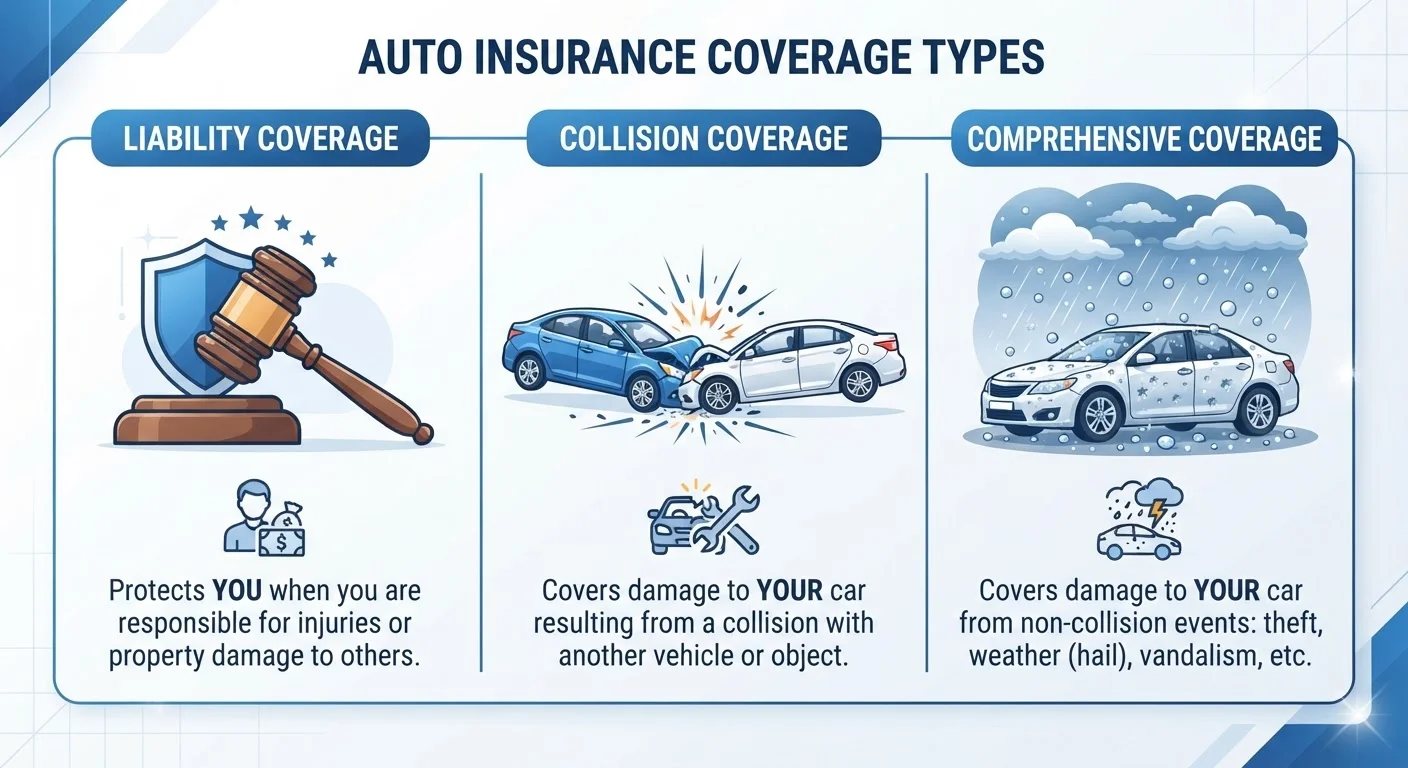
Photo credit: AdvisorHQ.net | Informative Website
In this article
Auto insurance has three main coverage types that work very differently. Here's what each protects — and what it doesn't.
Key Takeaways
- Liability coverage pays for damage and injuries you cause to others - it does not cover your own vehicle.
- Collision coverage pays to repair or replace your car after an accident, regardless of who was at fault.
- Comprehensive coverage handles non-collision damage such as theft, hail, floods, fire, and animal strikes.
- Most states legally require liability coverage; collision and comprehensive are generally optional unless a lender requires them.
- Each coverage type comes with its own deductible and limit, which directly affects your premium.
Liability Coverage: Protecting Others From Your Mistakes
Liability is the foundation of every auto insurance policy and is legally required in nearly every U.S. state. It exists to protect other people - not you - when you are at fault in an accident.
Liability coverage is typically split into two components:
- Bodily injury liability: Pays for medical expenses, lost wages, and pain-and-suffering claims for people you injure.
- Property damage liability: Pays to repair or replace another person's vehicle or property that you damage.
Policies express liability limits in a format such as 25/50/25, meaning $25,000 per injured person, $50,000 per accident for all injuries, and $25,000 for property damage. If damages exceed your limits, you are personally responsible for the difference - which is one reason many drivers carry coverage well above state minimums.
Critically, liability coverage never pays for your own medical bills or vehicle repairs. For that, you need different coverages entirely. For a deeper look at how these numbers and terms appear on a real policy, see our plain-language glossary of insurance terms.
Check Your State's Minimum Requirements
Every state sets its own minimum liability limits, and many experts suggest those minimums are too low to fully protect drivers in a serious accident. Review your state's requirements, then consider whether higher limits make sense for your financial situation. A licensed insurance agent can walk you through the tradeoffs.
Collision Coverage: Your Vehicle After an Accident
Collision coverage pays to repair or replace your vehicle when it is damaged in a traffic accident - regardless of who was at fault. This includes crashes with other vehicles, single-car accidents like hitting a guardrail, and rollovers.
Here's how it works in practice: after a covered accident, you file a claim, pay your chosen deductible, and your insurer covers the remaining repair costs up to the vehicle's actual cash value (ACV). If repair costs exceed the ACV, your insurer will typically declare the car a total loss and pay you the ACV instead.
Because collision coverage is tied to your vehicle's market value, its usefulness naturally decreases as the car ages and depreciates. Owners of older, lower-value vehicles sometimes find that the annual premium cost plus deductible approaches or exceeds what the insurer would pay in a worst-case scenario - a calculation worth reviewing periodically.
~88%
U.S. drivers carrying liability coverage
According to the Insurance Research Council, the vast majority of American drivers carry at least the state-minimum liability coverage, though rates of uninsured drivers vary significantly by state.
$3,750
Average collision claim payment
The Insurance Information Institute has reported average collision claim costs in the mid-thousands range, though actual amounts vary widely based on vehicle type, damage severity, and region.
~1 in 8
Drivers estimated to be uninsured
The Insurance Research Council estimates roughly one in eight U.S. drivers operates without insurance, underscoring why uninsured motorist coverage is a common policy add-on.
Comprehensive Coverage: When the Damage Isn't From a Crash
Comprehensive coverage handles vehicle damage caused by events outside your control that aren't collisions with another vehicle. Common covered events include:
- Theft and vandalism
- Hail, flooding, and wind damage
- Fire
- Falling objects (tree branches, debris)
- Animal strikes, such as hitting a deer
Like collision, comprehensive pays up to the actual cash value of your vehicle minus your deductible. It does not cover personal belongings stolen from inside the vehicle - those typically fall under a homeowners or renters insurance policy.
Comprehensive is sometimes misunderstood as covering "everything." It doesn't. Mechanical breakdowns, normal wear and tear, and engine failure are not covered. The term refers specifically to non-collision external events. Drivers who carry both collision and comprehensive together often hear the combination called "full coverage," though that phrase has no standard legal definition - as explored in our article on common auto insurance myths.
How These Three Coverages Work Together
Most drivers need to think about all three coverages in combination, not in isolation. A typical scenario illustrates the difference clearly:
- You rear-end another car → Your liability pays for their repairs and injuries. Your collision pays for damage to your own car.
- A hailstorm dents your hood → Comprehensive covers the repair.
- Someone runs a red light and hits you → Their liability pays for your damages (or your collision coverage steps in if they are uninsured).
Understanding what each coverage does - and doesn't - do helps you make better decisions about your deductibles and limits. Your premium, deductible choices, and vehicle value all interact. For a full breakdown of what shapes your rate, see our guide on factors that determine your auto insurance premium.
If you financed or leased your vehicle, your lender's requirements likely resolve the collision and comprehensive question for you. Once you own the car outright, the coverage decision is yours - and it's worth revisiting as the vehicle's value changes over time. Drivers who owe more on a loan than their car is worth may also want to explore how gap insurance works as an additional layer of protection.
This article is for general informational purposes only and does not constitute personalized insurance advice. Coverage terms, limits, exclusions, and legal requirements vary by state and insurer. Consult a licensed insurance professional and review your policy documents for guidance specific to your situation.
Frequently Asked Questions

Author
Cars & Driving Editorial Team
Cars & Driving Editorial Team is the collective byline for our editorial team and contributor network. Articles published under this byline or an editorial pen name are researched, written, and reviewed according to our editorial standards for clarity, consistency, and independence before publication.
View all articles →