
Good Debt vs. Bad Debt: Is the Distinction Actually Useful?
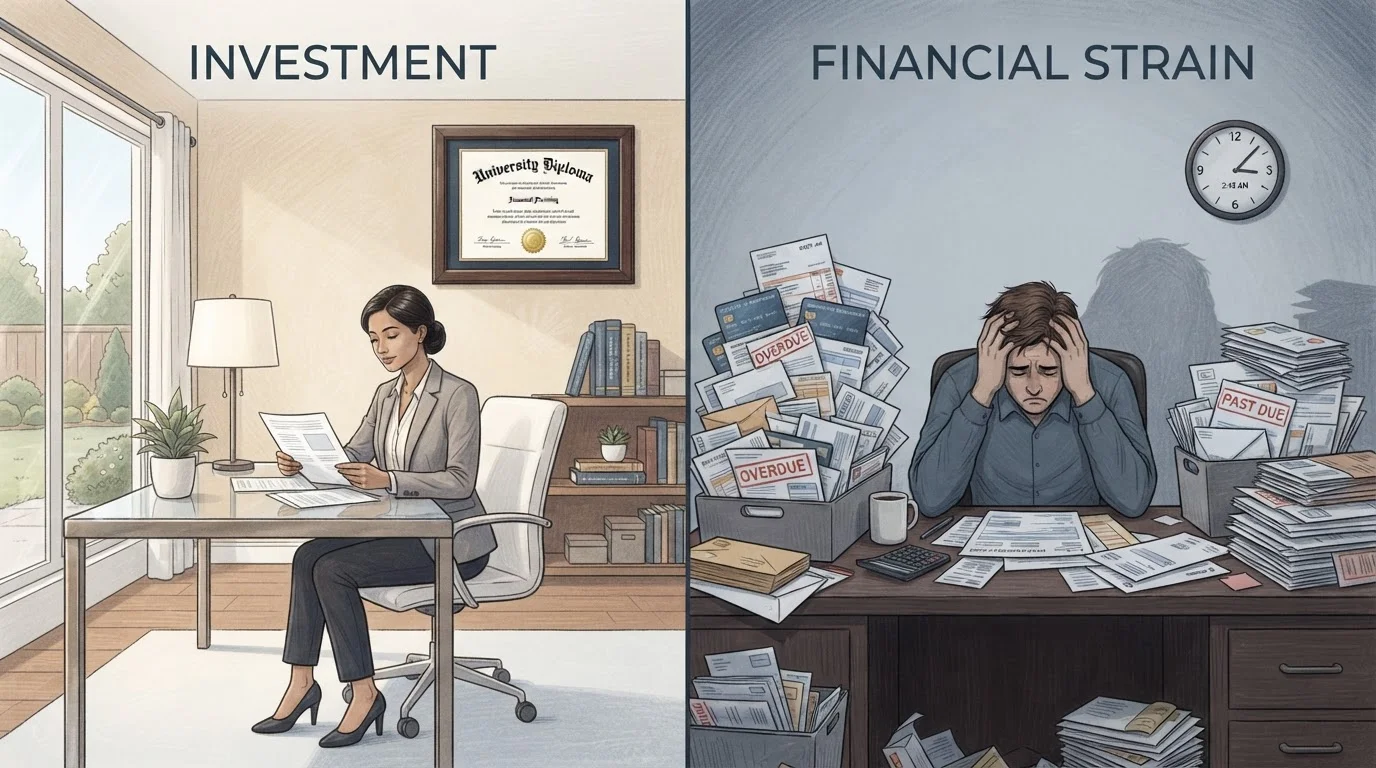
Photo credit: AdvisorHQ.net | Informative Website
In this article
Mortgages are often called "good debt" and credit cards "bad." Here's a clearer way to think about the debt you carry.
Key Takeaways
- The good/bad debt framework is a useful starting point but does not capture every borrowing situation accurately.
- Interest rate, loan purpose, and your ability to repay matter more than a simple label.
- So-called 'good' debt like student loans or mortgages can become burdensome depending on the amount and terms.
- High-interest consumer debt typically poses the greatest financial risk and warrants priority repayment.
- Context - your income, job stability, and overall financial picture - shapes whether any debt is manageable.
Where the Good Debt / Bad Debt Idea Comes From
The idea that some debt is "good" and other debt is "bad" has become a staple of personal finance advice. The basic logic goes like this: borrowing money to acquire something that grows in value or increases your earning power is good; borrowing to buy things that immediately lose value or disappear entirely is bad.
Under this framework, a mortgage falls in the "good" column because real estate has historically appreciated over time and the interest rate tends to be relatively low. Student loans often get classified the same way - the argument being that a degree raises your lifetime earning potential. Credit card balances and auto loans, by contrast, are frequently labeled "bad" because you're financing consumption or a depreciating asset, often at high interest rates.
It is a tidy framework, and it does carry some practical truth. But it also has meaningful blind spots that can mislead borrowers - especially those navigating borrowing decisions for the first time. Before accepting either label at face value, it helps to understand what the distinction actually measures and what it leaves out. For a solid grounding in the terminology involved, see our glossary for first-time borrowers.
Head-to-Head: How the Two Categories Stack Up
The table below outlines how the two debt categories are typically characterized across the factors that matter most to borrowers.
| Criterion | Good Debt | Bad Debt |
|---|---|---|
| Typical examples | Mortgages, student loans | Credit cards, payday loans |
| Interest rate range | Generally lower | Generally higher |
| Asset or value created | Often yes (home equity, credentials) | Rarely - funds consumption |
| Repayment structure | Fixed term, structured payments | Revolving or short-term, variable |
| Risk if mismanaged | Foreclosure, long repayment burden | Rapid balance growth, credit damage |
| Tax considerations | Mortgage interest may be deductible | Typically none |
These distinctions are broadly accurate as generalizations. But notice what is missing: the table says nothing about the borrower's income, job stability, or total debt load - all of which determine whether any debt is actually manageable. A $200,000 mortgage at a competitive interest rate is categorized as "good debt," but it can become deeply problematic if the borrower loses their income or takes on too much relative to what they earn.
Where the Framework Falls Short
The most significant limitation of the good/bad framework is that it focuses on the type of debt rather than the terms and context of the debt. Consider a few examples where the label and the reality diverge:
- Student loans: Traditionally labeled "good," yet the total amount borrowed, the field of study, and the actual job market for that field all determine whether the investment pays off. Borrowing $80,000 for a credential with limited earning potential in your area is a different financial proposition than borrowing $20,000 for a degree that consistently opens doors to well-paying work.
- Mortgages: Also typically "good," but housing markets vary significantly by region, and buying more home than your income supports can create long-term financial stress regardless of the asset's category.
- Auto loans: Usually labeled "bad" because vehicles depreciate, but a reliable car is often necessary for employment. A modest auto loan with a reasonable interest rate can be entirely appropriate for someone's situation.
These nuances matter. Common credit myths often follow the same pattern as the good/bad framework - they carry a grain of truth that becomes misleading when applied too broadly.
20%+
Typical credit card APR in recent years
The Federal Reserve tracks average credit card interest rates, which have exceeded 20% APR in recent reporting periods - illustrating why high-interest balances grow quickly.
~$1.6T
Total US student loan debt outstanding
Federal Reserve data shows outstanding student loan balances in the United States have reached roughly $1.6 trillion, underscoring how "good debt" can accumulate at a national scale.
43%
Americans carrying credit card balances month to month
According to the American Bankers Association, a significant share of cardholders carry a balance rather than paying in full each month, incurring ongoing interest charges.
A More Useful Way to Evaluate Debt
Rather than categorizing debt as inherently good or bad, a more practical approach focuses on three questions:
- What is the interest rate? Higher interest rates mean debt costs more over time and compounds faster. This is arguably the single most important number to understand. How compounding interest and minimum payments interact is something every borrower should understand before signing.
- Does this debt serve a purpose proportionate to its cost? This is a judgment call, but it encourages you to weigh the actual benefit - a home, a skill, reliable transportation - against the total cost of borrowing.
- Can you realistically manage the payments? Good intentions about future income or asset appreciation do not make payments. Your current cash flow and job stability determine whether any loan is workable right now.
If you already carry multiple types of debt and are trying to decide where to start, consistent debt management habits tend to matter more than how each loan is categorized. And if you are considering rolling balances together, it is worth reading about what debt consolidation actually solves before assuming it will simplify your situation.
This article is for general informational purposes only and does not constitute personalised financial or legal advice. Consult a qualified financial professional before making decisions specific to your circumstances.

Author
Finance Editorial Team
Finance Editorial Team is the collective byline for our editorial team and contributor network. Articles published under this byline or an editorial pen name are researched, written, and reviewed according to our editorial standards for clarity, consistency, and independence before publication.
View all articles →