
Tire Care From the Ground Up: Pressure, Tread, and Rotation
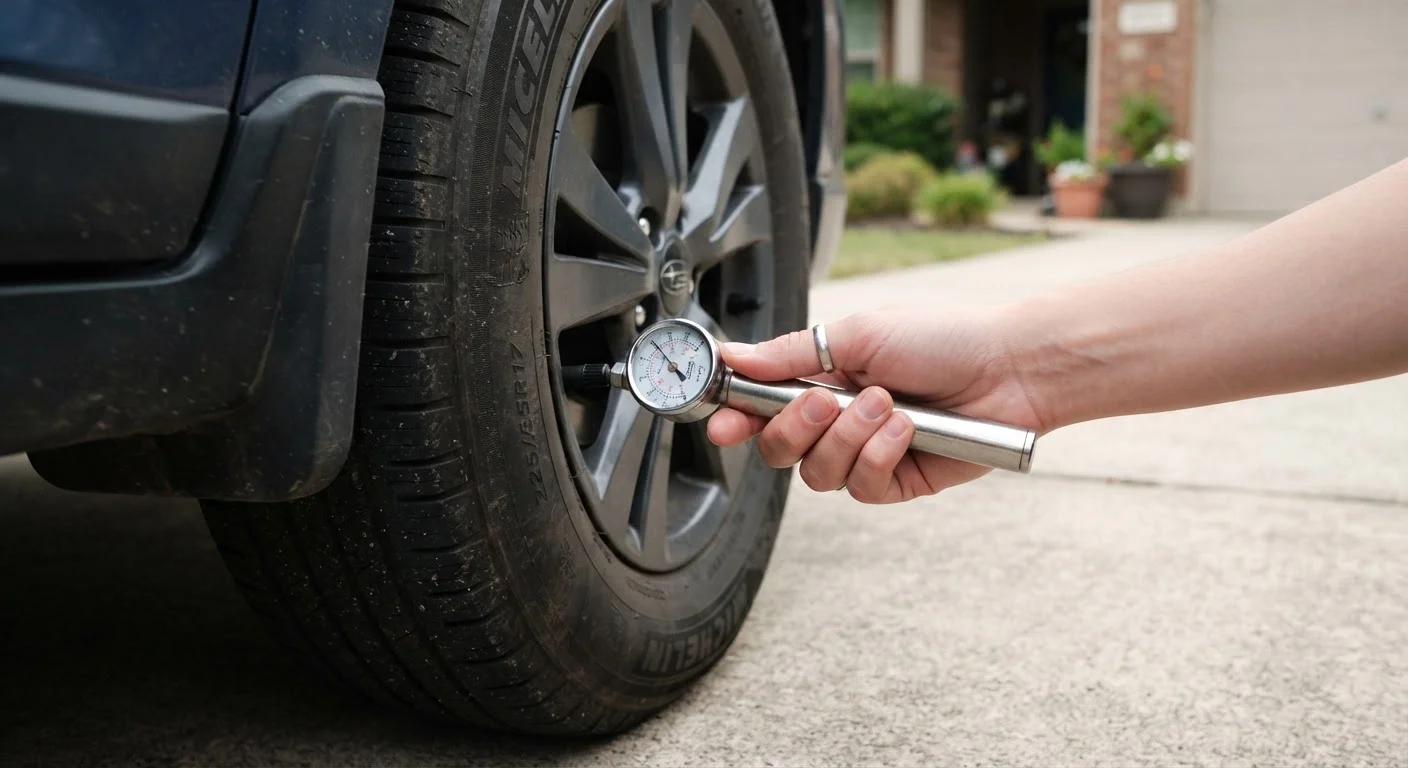
Photo credit: AdvisorHQ.net | Informative Website
In this article
Everything everyday drivers need to know about keeping tires safe, including how to check pressure, read tread wear, and when to rotate.
Key Takeaways
- Always check tire pressure when tires are cold, using the vehicle placard-not the number on the tire sidewall.
- The penny test is a quick way to gauge tread depth, but a dedicated tread-depth gauge gives more precise readings.
- Uneven tread wear is a symptom, not just wear-it points to alignment, inflation, or suspension issues.
- Most manufacturers recommend rotating tires every 5,000 to 7,500 miles to promote even wear.
- Proper tire care directly reduces the risk of hydroplaning, blowouts, and longer stopping distances.
Why Tire Care Matters More Than Most Drivers Realize
Tires are the only part of your vehicle in direct contact with the road. Every steering input, braking force, and acceleration load passes through four palm-sized contact patches - one per tire. When those patches are compromised by low pressure, worn tread, or uneven wear, the consequences range from reduced fuel economy to outright loss of vehicle control.
The good news is that tire care is among the most accessible forms of vehicle maintenance. No special tools, no pit time, and no mechanical expertise required for the basics. Whether you're checking in before a long road trip or building a monthly habit, understanding pressure, tread, and rotation gives you meaningful control over your vehicle's safety and operating costs. These fundamentals also tie directly into broader safety habits - see our pre-trip safety checklist for how tire checks fit into a complete pre-drive routine.
How to Check and Maintain Correct Tire Pressure
Tire pressure is measured in PSI. The correct PSI for your vehicle is set by the automaker and printed on a sticker inside the driver's door jamb - not on the tire sidewall, which shows the tire's maximum rated pressure, a different figure entirely.
To check pressure accurately, use a quality dial or digital gauge on a cold tire (one that hasn't been driven more than a mile). Heat from driving temporarily inflates pressure readings by several PSI, making a warm reading unreliable for adjustment purposes.
Check Pressure When Tires Are Cold
Always measure tire pressure before driving - or wait at least three hours after parking. Driving even a few miles raises internal tire temperature and artificially inflates pressure readings by several PSI. Checking cold ensures your reading matches the door-placard specification, which is also stated for cold conditions.
Steps to follow each time you check:
- Remove the valve cap and set it somewhere you won't lose it.
- Press the gauge firmly and squarely onto the valve stem until you get a steady reading.
- Compare the reading to your door-placard specification.
- Add air at a gas station compressor or portable inflator as needed; bleed air if the reading is too high.
- Replace the valve cap securely.
Check all four tires, including the spare if your vehicle carries a full-size spare. Tire pressure changes roughly 1 PSI for every 10°F shift in ambient temperature, so seasonal checks - particularly at the start of winter - are especially important.
~25%
Vehicles with at least one significantly underinflated tire
According to the National Highway Traffic Safety Administration (NHTSA), roughly one in four vehicles on U.S. roads has at least one tire underinflated by 25% or more.
1 PSI
Pressure drop per 10°F temperature decrease
Tire pressure changes approximately 1 PSI for every 10-degree Fahrenheit change in ambient temperature, according to general tire industry guidance.
4/32"
Tread depth at which wet-weather safety declines noticeably
Tire safety organizations and industry testing indicate that wet-road grip begins to degrade meaningfully below 4/32 of an inch of tread depth.
Reading Tread Wear: What Your Tires Are Telling You
New passenger tires typically have 10/32 to 11/32 of an inch of tread depth. The legal minimum in most U.S. states is 2/32 of an inch, and tire-safety organizations generally recommend replacement at 4/32 to maintain acceptable wet-weather performance. Worn tread dramatically increases the risk of hydroplaning - a danger explained in detail in our article on wet roads and hydroplaning.
Quick tread checks you can do yourself:
- Penny test: Insert a penny into a tread groove with Lincoln's head pointing down. If you can see the top of Lincoln's head, tread is at or below 2/32 - replace immediately.
- Quarter test: Use a quarter the same way. If you can see the top of Washington's head, you're at approximately 4/32 - time to plan for replacement soon.
- Tread wear indicators: Raised bars molded into the tread grooves appear flush with surrounding tread at 2/32. Visible indicator bars mean the tire is at the legal minimum.
Uneven wear patterns are diagnostic clues:
- Wear on both outer edges: Chronic underinflation.
- Wear in the center strip: Chronic overinflation.
- Wear on one edge only: Wheel alignment is likely off.
- Cupping or scalloping: Worn shock absorbers or struts.
Addressing the root cause - not just replacing the tire - prevents the same pattern from recurring on new rubber. For a broader view of vehicle wear items that interact with tires, see our guide on brake pad and rotor wear.
When diagnosing uneven tread wear, photograph the pattern before having the tires rotated or replaced - it gives your technician a clearer picture of the underlying cause.
Rotation or replacement erases the wear evidence. A photo preserves the diagnostic information so alignment or suspension issues aren't overlooked.
Keep a small digital tire gauge in your glove compartment rather than relying on gas station gauges, which can be inaccurate from heavy public use.
Consistency in your measurement tool reduces variables. A personal gauge used regularly gives you a reliable baseline for each tire on your vehicle.
Tire Rotation: When, Why, and How Often
Front and rear tires wear at different rates because they perform different jobs. On a front-wheel-drive vehicle, the front tires handle acceleration, steering, and a large share of braking - they typically wear faster. Rear-wheel-drive and all-wheel-drive vehicles have their own wear imbalances depending on drivetrain layout and driving style.
Rotation moves tires to different positions so that wear is distributed more evenly across all four, extending the overall lifespan of the set. Most vehicle manufacturers recommend rotating tires every 5,000 to 7,500 miles, though your owner's manual is always the definitive source. Many drivers align rotation with every other oil change as a convenient reminder.
Common rotation patterns include:
- Forward cross (front-wheel drive): Front tires move straight back; rear tires cross to opposite front positions.
- Rearward cross (rear- or all-wheel drive): Rear tires move straight forward; front tires cross to opposite rear positions.
- X-pattern: All four tires switch and cross simultaneously - used in some all-wheel-drive applications.
If your vehicle uses differently sized tires front and rear (a staggered fitment common on performance vehicles), a traditional rotation may not be possible - consult your owner's manual or a qualified technician.
Skipping Rotation Voids Some Tire Warranties
Many tire manufacturers include a mileage warranty that is contingent on documented regular rotations. If you need to make a warranty claim for premature wear, you may be asked to provide service records. Keep receipts or log rotation dates so you can demonstrate compliance if needed. Check your specific tire documentation for the exact terms.
Building a Simple Tire Maintenance Routine
Consistency matters more than perfection. A simple monthly habit - five minutes with a gauge and a visual inspection - catches most problems before they become costly or dangerous. Pair tire checks with your routine fluid inspections; our fluids checklist makes it easy to cover both during the same walk-around.
A practical monthly tire check covers:
- Pressure on all four tires (cold), compared to placard spec.
- Visual tread-depth assessment using the quarter or penny test.
- A look at each tire's sidewall for cracks, bulges, or embedded objects.
- A note of any vibration, pulling, or noise you've noticed while driving - these often have tire-related causes.
Scheduling a professional rotation and inspection at each oil change interval - or at least twice a year - gives a qualified technician the chance to catch issues your visual check might miss, including alignment drift and suspension wear. Tying these habits into your broader ownership responsibilities is straightforward: our routine maintenance guide shows how small consistent tasks prevent large unexpected bills.
Tires aren't glamorous, but they're foundational. Knowing what to look for - and acting on it regularly - is one of the most direct ways any driver can improve their vehicle's safety, efficiency, and longevity.

Author
Cars & Driving Editorial Team
Cars & Driving Editorial Team is the collective byline for our editorial team and contributor network. Articles published under this byline or an editorial pen name are researched, written, and reviewed according to our editorial standards for clarity, consistency, and independence before publication.
View all articles →