
Speed Limits: Advisory, Posted, and Safe - They're Not Always the Same Number
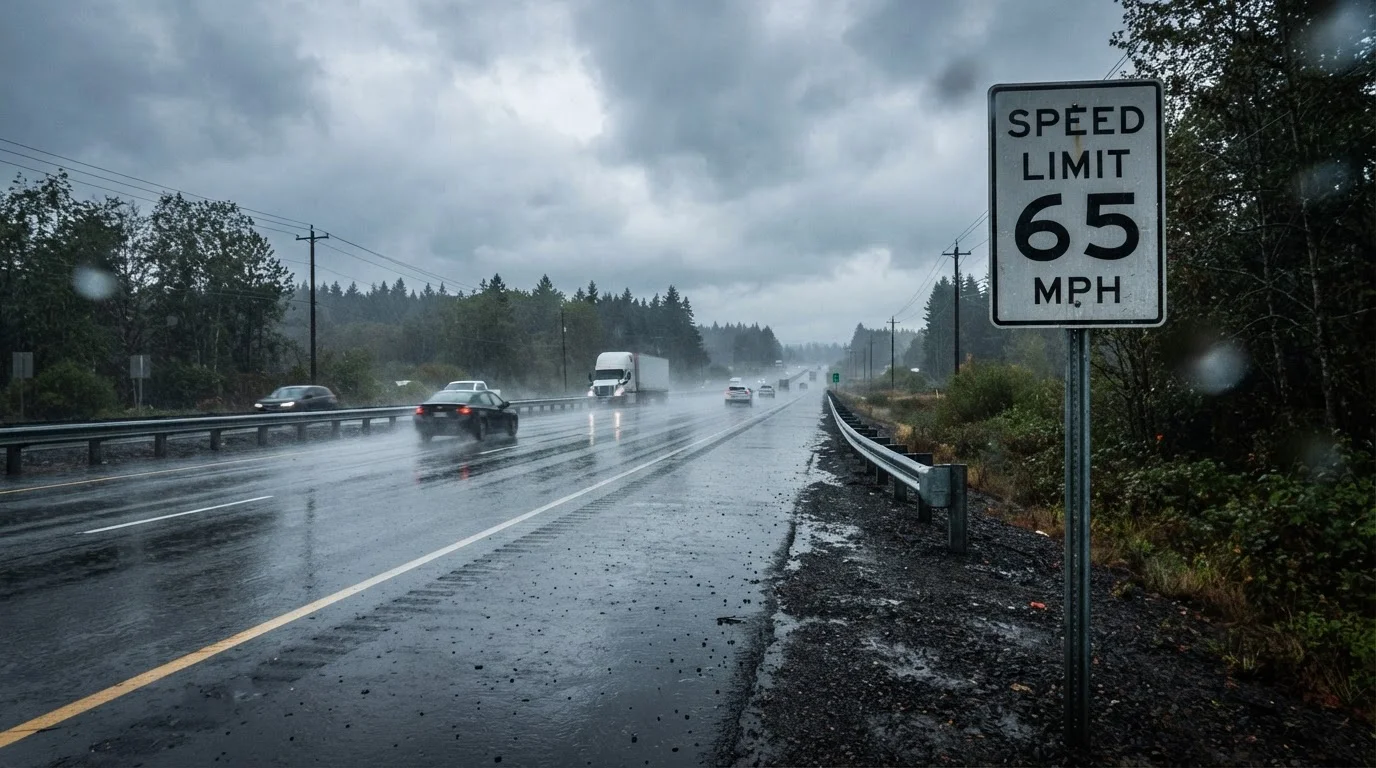
Photo credit: AdvisorHQ.net | Informative Website
In this article
Posted speed limits reflect legal maximums, not always safe speeds. Learn how to read road conditions and adjust your pace accordingly.
Key Takeaways
- Posted speed limits represent legal maximums under ideal conditions, not all-weather safe speeds.
- Advisory speed limits on warning signs are recommendations for specific hazards like sharp curves.
- Safe speed is always determined by actual conditions: weather, visibility, traffic, and road surface.
- Driving at the posted limit in poor conditions can still constitute reckless or negligent driving.
- Speed adjustments for conditions are both a legal obligation and a basic safety practice.
Three Different Numbers That Drivers Confuse
Most drivers see a speed limit sign and treat it as a target. In reality, any given stretch of road involves at least three distinct speed concepts - and understanding the difference between them is fundamental to safe driving.
Posted speed limits are the numbers on white regulatory signs. They represent the legally enforceable maximum for a road segment under normal, dry, daylight conditions. Setting them is a process guided by traffic engineering: transportation agencies typically study the natural speeds drivers choose, factoring in road geometry, land use, and crash history.
Advisory speeds appear on yellow warning signs - the kind you see approaching a sharp curve or a highway on-ramp. They are not legal limits, but rather engineering recommendations for the specific hazard ahead. Exceeding them doesn't automatically produce a ticket, but it dramatically raises your risk of losing control.
Safe speed is neither of the above. It's the speed appropriate for the actual conditions at that specific moment - and it's a judgment the driver must make continuously. Rain, fog, heavy traffic, construction zones, tire wear, and fatigue all affect what safe speed means in practice.
~29%
Fatal crashes involving speeding
According to the National Highway Traffic Safety Administration (NHTSA), speeding is a factor in roughly 29% of all traffic fatalities in recent reporting years.
3-4×
Stopping distance increase on ice vs. dry pavement
Traffic safety research consistently shows that stopping distances on ice can be three to four times longer than on dry pavement at the same speed.
35 mph
Speed at which hydroplaning risk increases sharply
Studies have found that tires on wet pavement begin to lose meaningful road contact at speeds starting around 35 mph, depending on tread depth and water depth.
What the Basic Speed Law Actually Requires
Nearly every U.S. state has some version of what traffic law calls the basic speed law (sometimes called the prima facie speed law). The core principle: regardless of what the sign says, you are legally required to drive at a speed that is reasonable and prudent given the actual conditions.
This means that driving at the posted limit during a blizzard, heavy fog, or a sudden downpour does not automatically protect you legally. If a crash occurs and investigators determine that conditions warranted a lower speed, a driver traveling at the posted limit can still be found negligent or reckless.
The practical upshot: the posted limit defines a ceiling, not a floor. It tells you the maximum you may drive - not the minimum you must drive. Weather dramatically changes what responsible driving looks like, and so does nighttime, heavy traffic, or any significant change in road surface.
A Simple Checkpoint Before Every Drive
Before pulling onto a road, briefly note the current visibility, road surface condition, and traffic density - then ask yourself whether the posted limit still feels appropriate. This 10-second mental check costs nothing and builds the habit of treating speed as a decision, not a default.
How Conditions Change Your Safe Speed
The most common mistake drivers make is treating speed as a constant setting rather than a variable input. Here are the core factors that should prompt a deliberate speed reduction:
- Wet or icy pavement: Stopping distances increase dramatically on wet roads and can multiply many times over on ice. Hydroplaning - where tires lose contact with the road surface - can occur at speeds most drivers consider normal, particularly during heavy rain.
- Reduced visibility: Your stopping distance must always be shorter than your sight distance. At night, your eyes process speed, distance, and contrast less reliably than in daylight, which means your perception of what's ahead is already compromised before conditions worsen further.
- Heavy traffic: Dense traffic cuts your available reaction time significantly. Following distance and speed are directly linked - the faster you go, the more space you need.
- Curves, hills, and intersections: Posted limits account for geometry, but advisory signs on curves serve as a reminder that you're approaching the edge of what the roadway was designed to handle.
Reducing speed is not timid driving - it is the precise adjustment that engineering standards, traffic law, and physics all recommend.
A driver traveling at the posted 65 mph limit on an interstate during a heavy rainstorm loses control after hitting a puddle and hydroplanes into another lane.
A yellow advisory sign before a mountain curve reads '25 mph,' while the posted road limit is 45 mph. A driver stays at 45 mph and runs wide on the curve.
On a clear, dry afternoon, a driver slows to 30 mph in a school zone where the posted limit temporarily drops to 20 mph during dismissal hours.
Making the Call: Practical Judgment in Real Traffic
Knowing that conditions should change your speed is straightforward in theory. Executing that judgment on a highway while managing traffic around you is harder. A few reliable principles help:
Use the stopping-distance rule. If you cannot bring your vehicle to a complete stop within the distance you can see clearly ahead - whether that visibility is cut by fog, a blind curve, or nightfall - you are going too fast. This principle holds regardless of the sign on the road.
Watch the road surface, not just the sky. A road can become slippery before rain is even visible on the windshield, particularly in the first few minutes of a shower when oils rise to the surface. Watch for sheen, standing water, or the absence of spray from vehicles ahead, which can indicate ice.
Account for your specific vehicle. A fully loaded pickup truck, a vehicle with worn tires, or an older car with a longer braking profile needs more distance to stop than the same vehicle under ideal conditions. Posted limits assume a typical passenger vehicle in good mechanical condition.
Ultimately, the driver - not the sign - bears responsibility for choosing an appropriate speed. Advisory signs, posted limits, and traffic engineering give you important reference points, but they are inputs to your judgment, not substitutes for it.
This article provides general driver education and is not legal advice. Traffic laws vary by state. Consult your state's motor vehicle code or a qualified legal professional for guidance specific to your jurisdiction.
Frequently Asked Questions

Author
Cars & Driving Editorial Team
Cars & Driving Editorial Team is the collective byline for our editorial team and contributor network. Articles published under this byline or an editorial pen name are researched, written, and reviewed according to our editorial standards for clarity, consistency, and independence before publication.
View all articles →