
Paying Yourself First vs. Budgeting What's Left: A Real Trade-Off
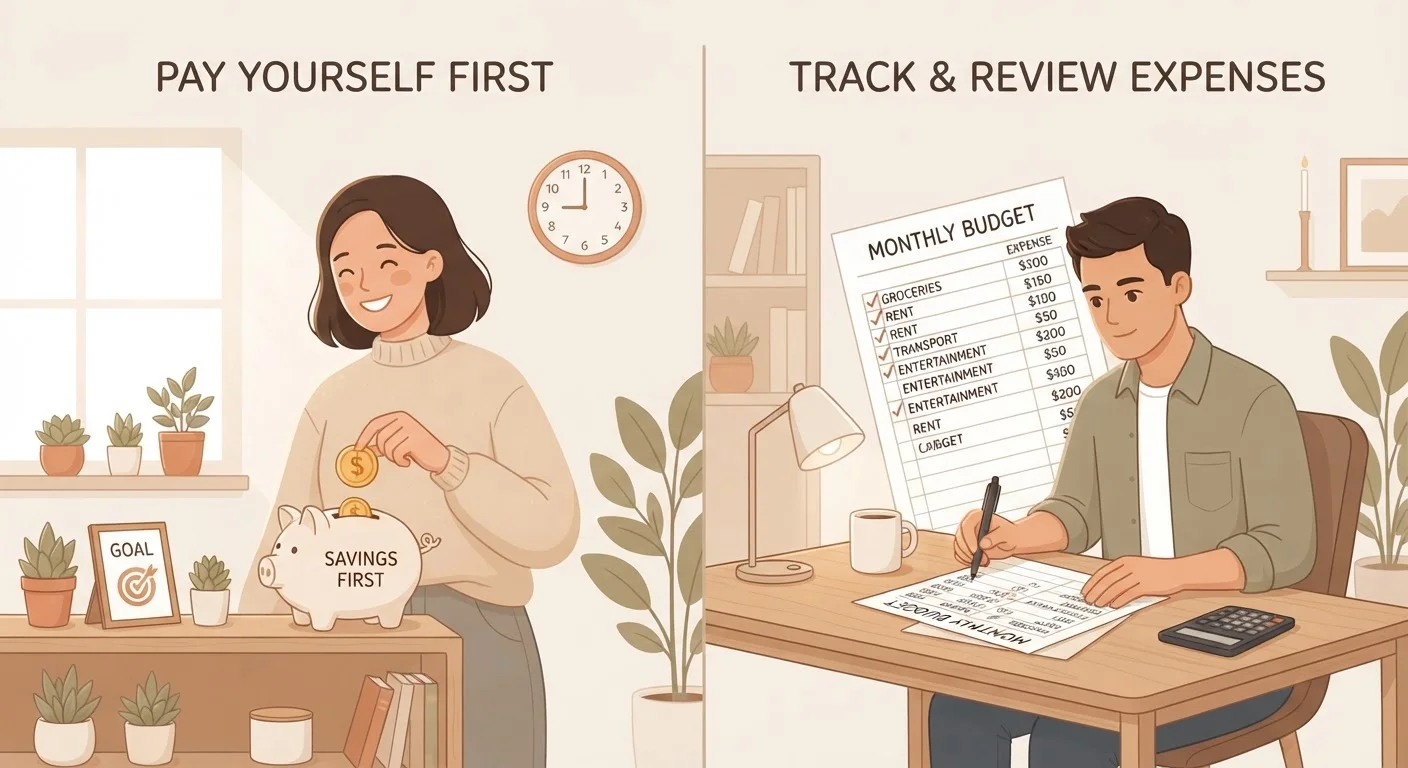
Photo credit: AdvisorHQ.net | Informative Website
In this article
Two opposing approaches to saving and spending — examined honestly so you can decide which philosophy suits your actual financial situation.
Key Takeaways
- Paying yourself first automates saving before discretionary spending begins, reducing reliance on willpower.
- Budgeting what's left gives you granular control but requires consistent tracking to be effective.
- Neither method is universally superior - your income stability and spending habits determine which fits better.
- Both approaches can be combined; many people pay themselves first and then budget remaining funds.
- Consult a qualified financial professional before making decisions that significantly affect your finances.
Automates saving before spending decisions intervene
By routing money to savings on payday, the method removes the temptation to spend first and save whatever survives. Automation is widely recognized as one of the most effective behavioral tools for consistent saving.
Reduces dependence on willpower and discipline
Because the transfer happens without manual action, short-term spending temptations have less opportunity to derail savings goals. The system is resistant to bad days or impulsive decisions.
Aligns with how tax-advantaged accounts work
Employer-sponsored retirement accounts like 401(k)s often use automatic payroll deductions - a structural match for the pay-yourself-first model, making it easy to integrate both.
Simpler to maintain over time
Once the automation is set up, the method requires minimal ongoing attention, which reduces the mental load of budgeting and makes long-term consistency more achievable.
Risk of overdraft if savings transfer is too large
If the automatic savings amount isn't calibrated to real take-home pay, the remaining funds may not cover essential expenses, leading to overdrafts or credit card reliance that undermine savings gains.
Provides little visibility into spending patterns
Without tracking where the remaining money goes, inefficiencies - unused subscriptions, excess dining out, category overspending - can persist for months without detection.
Left-over budgeting fails when surplus is zero
If income reliably covers only expenses with nothing remaining, the "budget what's left" method has no material to work with, making savings impossible without first reducing expenses or increasing income.
Detail-focused budgeting demands sustained effort
Tracking spending across multiple categories every month requires consistent attention. Most people find this difficult to maintain indefinitely, and lapses in tracking tend to produce lapses in saving.
What Each Approach Actually Means
Both strategies share the same goal - setting money aside before it disappears into day-to-day spending - but they reach that goal in opposite directions.
Paying yourself first means directing a predetermined amount into savings or an investment account the moment income arrives, before any bill is paid or purchase is made. The savings transfer happens automatically; you live on whatever remains. This concept is sometimes called a "reverse budget" because spending is the afterthought, not the savings.
Budgeting what's left takes the traditional approach: tally your income, subtract all fixed and variable expenses, and consciously decide what to save from the surplus. If there is no surplus, savings don't happen that month. It requires active, ongoing tracking - something tools like spreadsheets or dedicated apps can support. See our comparison of spreadsheet and app-based budgeting for a deeper look at the mechanics.
The philosophical divide matters: one method treats saving as a fixed obligation; the other treats it as a residual reward for disciplined spending.
The Case for Paying Yourself First
The strongest argument for this method is behavioral. Humans reliably adapt spending to available resources - a phenomenon sometimes called "lifestyle creep" - and automation short-circuits that tendency before it starts.
Automates saving before spending decisions intervene
By routing money to savings on payday, the method removes the temptation to spend first and save whatever survives. Automation is widely recognized as one of the most effective behavioral tools for consistent saving.
Reduces dependence on willpower and discipline
Because the transfer happens without manual action, short-term spending temptations have less opportunity to derail savings goals. The system is resistant to bad days or impulsive decisions.
Aligns with how tax-advantaged accounts work
Employer-sponsored retirement accounts like 401(k)s often use automatic payroll deductions - a structural match for the pay-yourself-first model, making it easy to integrate both.
Simpler to maintain over time
Once the automation is set up, the method requires minimal ongoing attention, which reduces the mental load of budgeting and makes long-term consistency more achievable.
When a transfer to a retirement account or emergency fund is scheduled alongside direct deposit, saving becomes a non-negotiable line item rather than a goal that competes with groceries, subscriptions, and social spending. Research in behavioral economics consistently finds that default enrollment and automatic contributions increase savings participation. This is precisely why many employer 401(k) plans use auto-enrollment - it works. For context on how those accounts function, see our guide to 401(k)s and IRAs.
The method also builds durable savings habits because the system does the work, not willpower alone.
The Case for Budgeting What's Left
Detailed budgeting rewards those who need visibility - particularly people managing variable income, carrying high-interest debt, or navigating a financial reset after a major life change.
Risk of overdraft if savings transfer is too large
If the automatic savings amount isn't calibrated to real take-home pay, the remaining funds may not cover essential expenses, leading to overdrafts or credit card reliance that undermine savings gains.
Provides little visibility into spending patterns
Without tracking where the remaining money goes, inefficiencies - unused subscriptions, excess dining out, category overspending - can persist for months without detection.
Left-over budgeting fails when surplus is zero
If income reliably covers only expenses with nothing remaining, the "budget what's left" method has no material to work with, making savings impossible without first reducing expenses or increasing income.
Detail-focused budgeting demands sustained effort
Tracking spending across multiple categories every month requires consistent attention. Most people find this difficult to maintain indefinitely, and lapses in tracking tend to produce lapses in saving.
When you track every category - housing, food, transportation, utilities - you can identify exactly where money leaks. That precision is valuable. Someone repaying debt using a structured method, for instance, needs to know their exact monthly surplus before deciding how much extra to throw at a balance. For a look at how payoff methods differ, see our breakdown of avalanche vs. snowball debt repayment.
Left-over budgeting also pairs naturally with zero-based budgeting, which assigns every dollar a designated purpose before the month begins - a structure that can prevent overspending in any single category.
For freelancers or hourly workers whose income fluctuates, this method is often more realistic. Our guide to budgeting on irregular income explains strategies tailored to unpredictable paychecks.
Where Each Method Breaks Down
Pay-yourself-first fails when the automatic savings amount is set too high relative to actual take-home pay. Overdrafts, missed bill payments, or credit card reliance to cover gaps can quickly erase any savings advantage. The method also provides less visibility into spending patterns, so inefficiencies can persist unnoticed for months.
When Your Income Varies Month to Month
Pay-yourself-first is harder to implement when income isn't predictable. Setting a fixed automatic transfer on a variable paycheck risks shortfalls in low-income months. Freelancers and hourly workers often do better establishing a minimum baseline savings transfer and adjusting manually each month based on actual earnings. A percentage-based target - saving a fixed share of whatever arrives - can bridge both methods in irregular-income situations.
Left-over budgeting breaks down when "what's left" is consistently zero or negative. Without a surplus, the system has nothing to allocate. It also demands sustained attention - most people find detailed monthly tracking difficult to maintain, and gaps in tracking lead to gaps in savings. If expenses reliably consume all income, the budget reveals a problem but doesn't solve it.
Your savings rate - the share of income actually set aside - is a useful diagnostic regardless of which method you use. A low or zero savings rate signals that either the chosen method isn't working, or the underlying income-to-expense ratio needs attention first.
Choosing - or Combining - Both
The binary framing of "which is better" is somewhat artificial. Many households effectively use both: a fixed automatic transfer handles baseline savings, while the remaining income is tracked and allocated deliberately. This hybrid captures automation's reliability and budgeting's transparency.
~55%
Americans living paycheck to paycheck
Various surveys conducted in recent years consistently find that a majority of US adults report difficulty covering expenses between pay periods, underlining why savings method matters.
Auto-enrollment
Key driver of retirement savings participation
Studies examining 401(k) participation rates have found that automatic enrollment dramatically increases the share of workers who contribute, supporting the behavioral argument behind pay-yourself-first.
If you're new to any structured approach, the introduction to budgeting fundamentals provides a grounding in what either method requires before you commit. Those wanting a side-by-side look at specific frameworks may also benefit from comparing the 50/30/20 rule and envelope budgeting.
Neither approach guarantees financial security - both require honest assessment of your income, obligations, and goals. Consulting a licensed financial adviser before making significant changes to your saving or investing strategy is always worthwhile.
This article is for general informational and educational purposes only and does not constitute personalised financial, investment, tax, or legal advice. Please consult a qualified financial professional for guidance specific to your situation.

Author
Finance Editorial Team
Finance Editorial Team is the collective byline for our editorial team and contributor network. Articles published under this byline or an editorial pen name are researched, written, and reviewed according to our editorial standards for clarity, consistency, and independence before publication.
View all articles →