
Cruise Control on Wet or Icy Roads: A Closer Look at the Risk
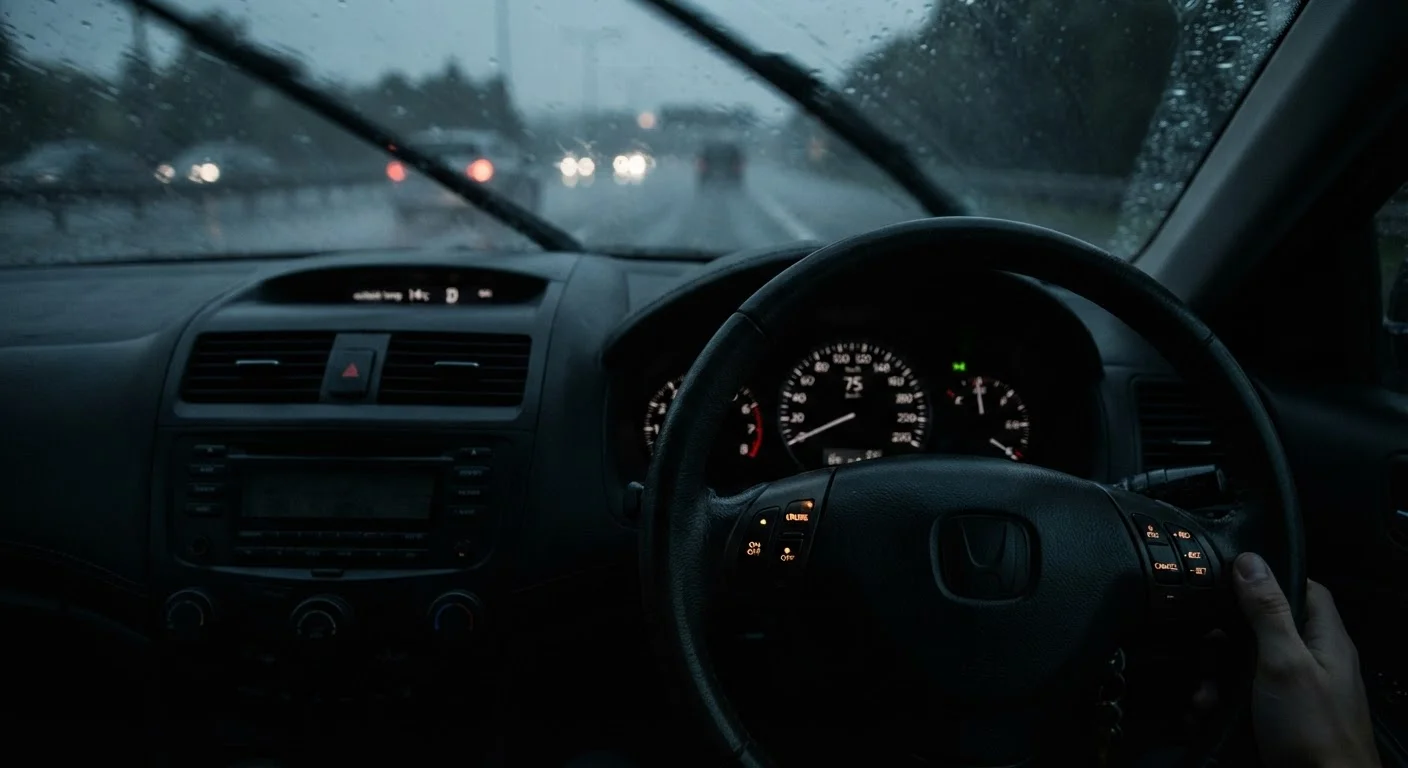
Photo credit: AdvisorHQ.net | Informative Website
In this article
Many drivers use cruise control in all conditions without thinking twice. Here's why wet and icy roads change the equation significantly.
Key Takeaways
- Cruise control reduces a driver's ability to react quickly when traction is compromised.
- On wet or icy roads, maintaining consistent speed can cause or worsen a skid or hydroplane event.
- Modern adaptive cruise control does not fully eliminate the risks of slippery-surface driving.
- Turning off cruise control in adverse weather is one of the simplest safety steps a driver can take.
- Human judgment and active throttle control are essential on low-traction surfaces.
Reduces driver fatigue on long highway trips
Maintaining a steady foot position for hours strains the leg and can contribute to inattention. Cruise control removes that physical demand on open, dry roads.
Helps maintain consistent legal speeds
Drivers often unintentionally creep above the speed limit on flat, open roads. Cruise control eliminates that drift on suitable surfaces.
Can improve fuel efficiency at steady speeds
Smooth, consistent throttle application on dry highways tends to be more fuel-efficient than the small accelerations and decelerations of manual driving.
Useful in low-traffic, good-weather highway conditions
On dry, well-maintained interstates with light traffic, cruise control lets a driver focus attention on the road environment rather than the speedometer.
Throttle response can trigger or worsen a skid
When a tire loses grip on a wet surface, cruise control may increase power to recover the set speed, potentially causing the vehicle to spin or slide further.
Reduces driver engagement and reaction speed
Cruise control encourages a passive mental state; when a traction event occurs suddenly, a disengaged driver will be slower to respond than one actively managing the throttle.
Increases hydroplaning risk at sustained speeds
Hydroplaning is most likely at higher, sustained speeds on standing water. Cruise control maintains exactly those speeds rather than allowing the natural speed reduction that manual driving provides.
Designed for stable conditions, not variable grip
Cruise control systems are engineered around the assumption of predictable traction; they have no sensor input for road surface grip levels and cannot anticipate ice patches or pooled water.
Disengagement itself can cause abrupt speed changes
On icy roads, the sudden deceleration that occurs when cruise control is disengaged mid-skid can itself cause loss of control if the driver doesn't respond smoothly.
Why Cruise Control Behaves Differently on Low-Traction Surfaces
Cruise control maintains a set speed by automatically adjusting engine throttle - and, in some systems, applying light braking. On dry pavement this works seamlessly. On a wet or icy road, that same automatic throttle adjustment can deliver power to the wheels at precisely the wrong moment, breaking traction before a driver has any chance to respond.
When a tire loses grip momentarily on a slick surface, a driver's instinct is to ease off the accelerator. Cruise control does the opposite: it may increase throttle to compensate for the speed drop caused by reduced traction. This can initiate or deepen a skid. Understanding how hydroplaning develops makes it easier to see why any system that adds throttle autonomously is a liability in those moments.
Traction Control Is Not the Same Protection
Many drivers assume that traction control or electronic stability control (ESC) neutralizes the risks of cruise control on slippery roads. These systems can reduce wheel spin and help correct a skid once it begins, but they operate reactively - after traction has already been lost. They do not prevent cruise control from issuing an ill-timed throttle increase in the first place. Proactive disengagement of cruise control remains the more reliable safeguard.
The Pros of Cruise Control (In the Right Conditions)
Cruise control has real, well-established benefits - they simply don't apply uniformly across all road conditions.
Reduces driver fatigue on long highway trips
Maintaining a steady foot position for hours strains the leg and can contribute to inattention. Cruise control removes that physical demand on open, dry roads.
Helps maintain consistent legal speeds
Drivers often unintentionally creep above the speed limit on flat, open roads. Cruise control eliminates that drift on suitable surfaces.
Can improve fuel efficiency at steady speeds
Smooth, consistent throttle application on dry highways tends to be more fuel-efficient than the small accelerations and decelerations of manual driving.
Useful in low-traffic, good-weather highway conditions
On dry, well-maintained interstates with light traffic, cruise control lets a driver focus attention on the road environment rather than the speedometer.
The Cons of Using Cruise Control on Wet or Icy Roads
The disadvantages below are specific to slippery or compromised surfaces, not cruise control's general function on dry roads.
Throttle response can trigger or worsen a skid
When a tire loses grip on a wet surface, cruise control may increase power to recover the set speed, potentially causing the vehicle to spin or slide further.
Reduces driver engagement and reaction speed
Cruise control encourages a passive mental state; when a traction event occurs suddenly, a disengaged driver will be slower to respond than one actively managing the throttle.
Increases hydroplaning risk at sustained speeds
Hydroplaning is most likely at higher, sustained speeds on standing water. Cruise control maintains exactly those speeds rather than allowing the natural speed reduction that manual driving provides.
Designed for stable conditions, not variable grip
Cruise control systems are engineered around the assumption of predictable traction; they have no sensor input for road surface grip levels and cannot anticipate ice patches or pooled water.
Disengagement itself can cause abrupt speed changes
On icy roads, the sudden deceleration that occurs when cruise control is disengaged mid-skid can itself cause loss of control if the driver doesn't respond smoothly.
~11%
Reduction in stopping distance on wet vs. dry roads
Wet pavement can increase stopping distances by 50% or more compared to dry conditions, according to general traffic safety guidance from the Federal Highway Administration.
35+ mph
Speed at which hydroplaning risk becomes significant
Traffic safety researchers generally note that hydroplaning can begin at speeds above approximately 35 mph on wet pavement, depending on tire tread depth and water depth.
Does Adaptive Cruise Control Change the Picture?
Adaptive cruise control (ACC) - which adjusts speed based on the vehicle ahead using radar or cameras - is an improvement over basic cruise control, but it does not solve the wet- and ice-driving problem. ACC is designed primarily to manage following distance in traffic. It is not a traction-management system. The throttle-and-brake commands it issues are still automated, still reactive, and still subject to the same physics that make conventional cruise control risky in low-grip conditions.
Some vehicles pair ACC with stability control and traction control systems, which can intervene during a skid. However, those systems work by reducing engine power or applying individual wheel brakes - they are emergency corrective tools, not a substitute for proactive driver judgment. The safest approach remains disengaging cruise control when rain, sleet, snow, or standing water is present, and resuming full manual throttle control. This aligns with the broader discipline of adjusting your driving to match conditions.
Practical Steps for Safer Wet-Weather Driving
Turning off cruise control is a start, but it's one part of a larger approach to adverse-weather driving. Habits that erode over time - like maintaining greater following distance and reducing speed in rain - matter just as much. Before any drive in uncertain weather, a pre-trip safety check that covers tire pressure and tread depth can also reduce your exposure to traction loss. And if you're heading into a season change, seasonal vehicle preparation - including checking wiper blades and tire condition - gives your car the best foundation for handling compromised roads.
The core principle is simple: on any surface where your tires may not grip predictably, the driver should be in direct, unmediated control of acceleration. Cruise control removes that directness. In good conditions, that's a convenience. In bad conditions, it's a risk not worth taking.
This article is for general informational purposes only. Always consult your vehicle owner's manual for guidance specific to your vehicle's driver-assistance systems, and exercise personal judgment when driving in adverse weather conditions.

Author
Cars & Driving Editorial Team
Cars & Driving Editorial Team is the collective byline for our editorial team and contributor network. Articles published under this byline or an editorial pen name are researched, written, and reviewed according to our editorial standards for clarity, consistency, and independence before publication.
View all articles →