
Defensive Driving vs. Aggressive Driving: Where the Line Actually Falls
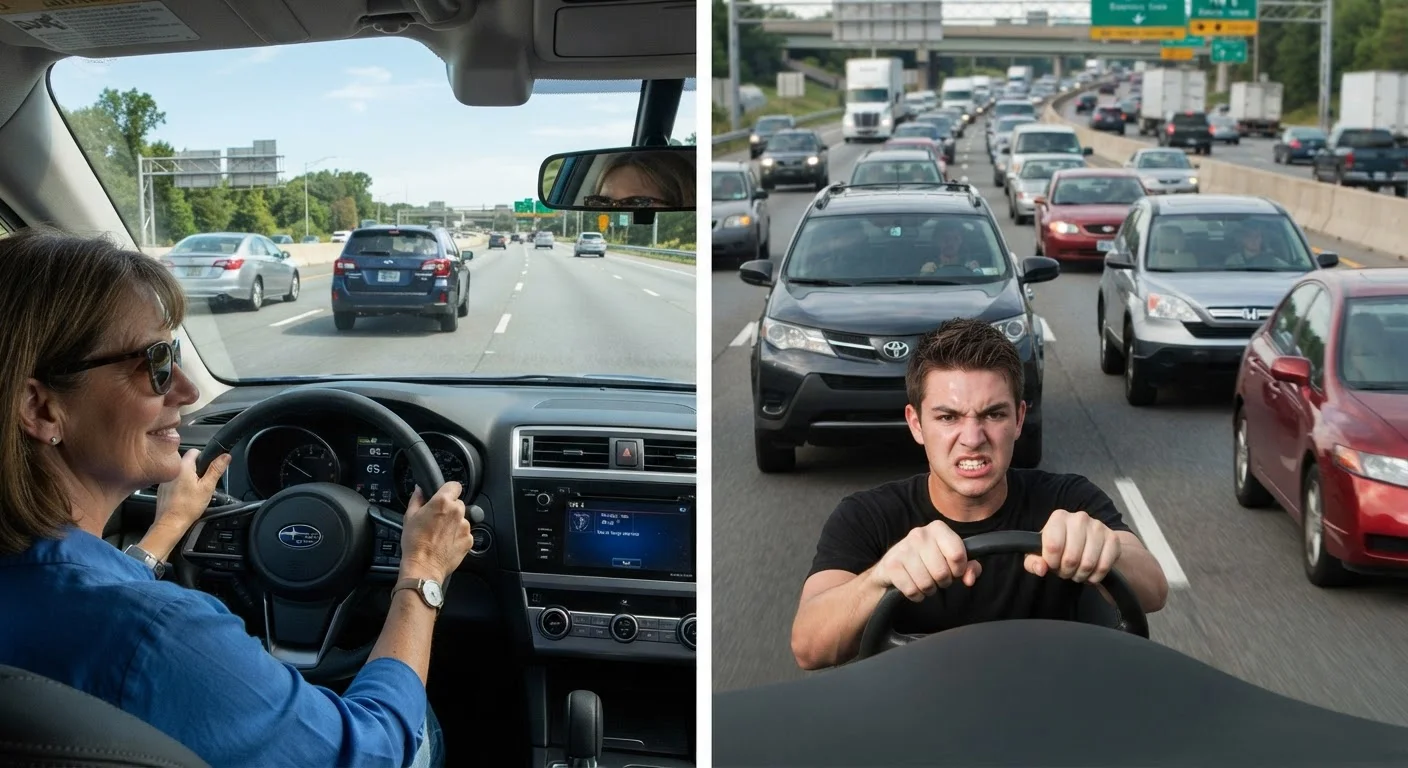
Photo credit: AdvisorHQ.net | Informative Website
In this article
Many drivers believe they drive defensively when they don't. Explore the real difference between anticipating danger and creating it.
Key Takeaways
- Defensive driving means anticipating hazards before they develop, not simply reacting to them.
- Aggressive driving is defined by patterns - tailgating, frequent lane changes, and speeding - not just one-time frustration.
- Many drivers genuinely believe they drive defensively while regularly exhibiting aggressive behaviors.
- Following distance and speed management are two of the clearest behavioral lines between the two styles.
- Recognizing aggressive habits in yourself is the first step toward correcting them.
The Core Distinction Most Drivers Get Wrong
Most people rate themselves as safe drivers. Research from the AAA Foundation for Traffic Safety has consistently found that a large majority of drivers consider themselves better-than-average, even while admitting to behaviors - speeding, tailgating, running red lights - that contradict that self-assessment. This gap is exactly where the confusion between defensive and aggressive driving lives.
Defensive driving is not merely cautious or slow driving. It is a deliberate, forward-looking approach: scanning for hazards two to four seconds ahead, maintaining safe following distances, and making decisions that account for what other road users might do unpredictably. It means yielding when you have the right of way if doing so prevents a collision, and adjusting your speed to conditions rather than the posted limit alone.
Aggressive driving, by contrast, is defined by the National Highway Traffic Safety Administration (NHTSA) as operating a vehicle in a way that endangers or is likely to endanger persons or property. It is a pattern - not a single moment of frustration - characterized by behaviors that prioritize the driver's progress over shared road safety.
The line falls here: defensive driving accepts that you cannot control other drivers; aggressive driving behaves as though you can - or should.
Behaviors That Reveal Which Side You're On
The clearest way to distinguish the two styles is to examine specific, observable behaviors. Most aggressive driving patterns involve narrowing safety margins - reducing time and space - while defensive driving consistently works to expand them.
| Criterion | Defensive Driving | Aggressive Driving |
|---|---|---|
| Following distance | 3+ seconds; more in adverse conditions | Under 2 seconds; used as pressure |
| Speed management | Adjusted to conditions, not just posted limit | Speed used to assert road position |
| Lane changes | Signaled early, blind spots fully checked | Frequent, unsignaled, forcing gaps |
| Response to slow traffic | Patience; adjust route if needed | Tailgating, flashing lights, weaving |
| Right-of-way attitude | Yields to prevent collision even if entitled | Asserts right-of-way regardless of risk |
| Emotional state | Calm; frustration managed consciously | Frustration drives speed and spacing decisions |
| Risk to others | Minimized through wider safety margins | Elevated; margins narrowed for personal progress |
Following distance is one of the most telling indicators. Defensive drivers maintain at least a three-second gap under normal conditions and extend that buffer in rain, heavy traffic, or at highway speeds. Aggressive drivers close that gap - often to less than a second - as a way of pressuring the car ahead to move over. Our article on what following distance communicates to other drivers explains how spacing signals intent far beyond personal safety.
Lane changing also separates the two approaches. Defensive drivers signal early, check blind spots fully, and merge only when sufficient space exists. Aggressive drivers weave frequently across lanes, often without signaling, treating gaps as targets rather than safety margins. For a detailed look at proper technique, see highway merging done right.
Speed management is another dividing line. Defensive driving means adjusting to road conditions - slowing in rain, construction zones, or reduced visibility - even when traffic flows faster. Aggressive driving treats the posted limit as a floor, not a ceiling, and uses speed to assert road position.
The Gray Zone: Habits That Feel Justified But Aren't
Some of the most common aggressive behaviors persist because drivers have rationalized them. These are the gray-zone habits worth examining honestly.
When Habit Becomes Pattern
A single aggressive maneuver doesn't make someone an aggressive driver. The concern arises when these behaviors become the default response to any perceived obstacle or delay. NHTSA data suggests aggressive driving plays a role in a significant share of traffic fatalities annually in the United States. Patterns matter more than isolated moments.
- "I only tailgate when they're going too slow in the fast lane." Frustration doesn't change physics. A following distance under two seconds at 70 mph leaves virtually no reaction time if the vehicle ahead brakes suddenly.
- "I speed up to merge - that's what you're supposed to do." Matching traffic speed during a merge is correct; accelerating well past it to force a gap is aggressive.
- "I flash my lights to warn people, not to intimidate." Context matters. Repeated high-beam flashing directed at a driver who won't yield crosses into aggressive signaling and can escalate conflict rapidly.
- "I'm a confident driver - I don't need as much following distance." Confidence affects decision-making time, not stopping distance. Braking physics are the same for every driver.
These rationalizations are a core reason that experienced drivers often let safety habits slip. Familiarity with roads can breed the exact overconfidence that defensive driving is designed to counteract. Wet conditions make this doubly important - review our guide on understanding hydroplaning to see how reduced margins combine with weather to escalate risk fast.
When these habits cluster and become a consistent response to perceived road frustration, they begin to shade into road rage territory - a separate but related problem covered in depth in what triggers road rage and how to break the cycle.
Building a Genuinely Defensive Mindset
Defensive driving is less a skill set than a mental framework - one that requires deliberate maintenance. Key principles include:
- Assume unpredictability. Other drivers will merge without signaling, brake without warning, and make decisions you won't anticipate. Build your margins around that reality.
- Use the two-second rule - minimum. In poor visibility, rain, or at speeds above 55 mph, extend to four seconds or more. See our coverage of wet road hazards for how quickly this buffer can disappear in adverse conditions.
- Scan ahead, not just immediately in front. Effective hazard anticipation requires reading traffic two to four vehicles ahead and watching brake lights, pedestrian movements, and merge patterns early.
- Control your emotional response. Aggressive driving is often emotionally driven. Recognizing when frustration is starting to shape your speed or spacing decisions is itself a defensive skill.
None of this requires driving slowly or timidly. Defensive driving is compatible with confident, efficient highway driving - it simply keeps the priority on arriving safely rather than arriving first.

Author
Cars & Driving Editorial Team
Cars & Driving Editorial Team is the collective byline for our editorial team and contributor network. Articles published under this byline or an editorial pen name are researched, written, and reviewed according to our editorial standards for clarity, consistency, and independence before publication.
View all articles →